
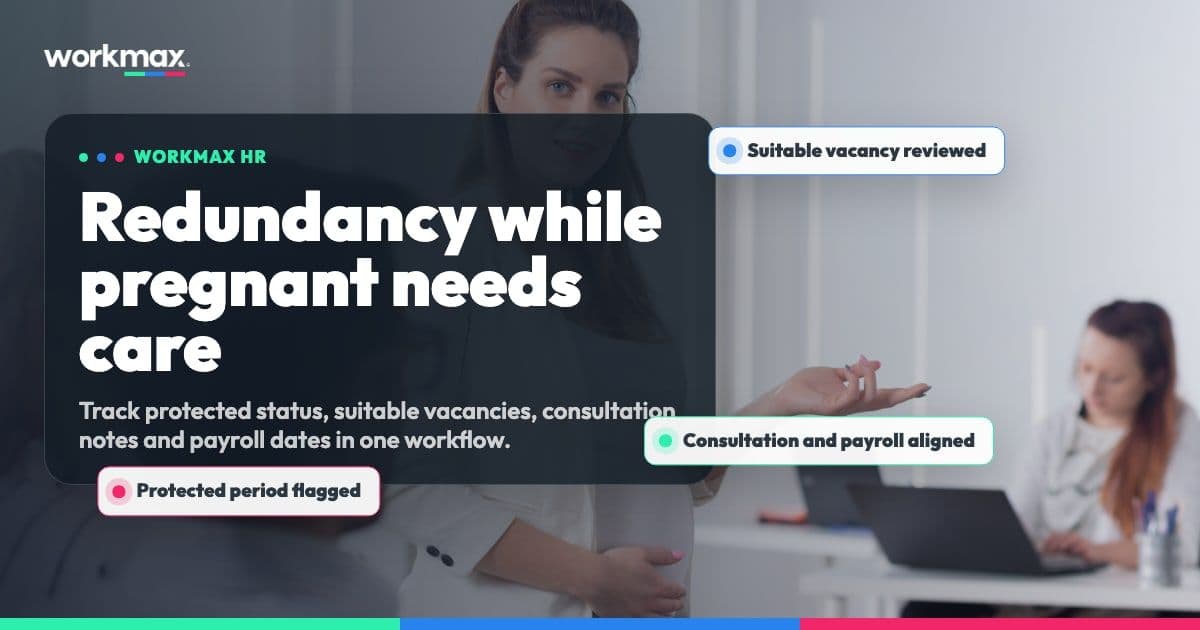
Yes, someone can be made redundant while pregnant in the UK, but pregnancy cannot be the reason for the redundancy.
That distinction matters. A genuine redundancy can still happen during pregnancy if the employer is really reducing roles, closing a workplace, or changing the need for certain work. But if pregnancy influences the selection, the process, or the decision not to offer a suitable alternative role, the dismissal may be unfair and could also amount to pregnancy and maternity discrimination.
This guide is general UK information, not legal advice. Redundancy disputes are fact-sensitive, so employers and employees should check the official guidance and get advice on the exact situation.
The short version
If an employee is pregnant and at risk of redundancy, the employer still needs to run a real redundancy process. But the employee also has extra protection.
In practice, that means:
- pregnancy is not a valid reason to select someone for redundancy;
- the employer should consult properly and explain why the role is at risk;
- if there is a suitable alternative vacancy, the employer must offer it as a priority during the protected period;
- if the employee is dismissed while pregnant, the employer must give written reasons;
- the employee may still have rights to notice pay, redundancy pay, maternity leave, and maternity pay depending on the facts.
What counts as a genuine redundancy?
Redundancy is about the role, not the pregnancy.
A redundancy situation may exist where:
- the employer is closing the business;
- the employer is closing a particular workplace;
- the need for employees to do certain work has reduced.
That is the legal and practical starting point. If the business still needs the same role and simply wants to remove the pregnant employee, that is not a genuine redundancy.
Can a pregnant employee be selected for redundancy?
Only if the selection is genuinely fair and unrelated to the pregnancy.
GOV.UK says employees cannot be selected for redundancy because of pregnancy, birth, or maternity leave. Acas also states that pregnancy is never a valid reason to dismiss someone.
That means an employer should be able to explain:
- why the role is at risk;
- what pool was used for selection, if there is one;
- what criteria were applied;
- how consultation was handled;
- why the decision would have been the same if the employee were not pregnant.
If those answers are vague, inconsistent, or obviously influenced by pregnancy-related absence or assumptions about future availability, the process is already on weak ground.
The extra redundancy protection during pregnancy
This is the part many employers still miss.
From 6 April 2024, redundancy protection for pregnancy and new parents was extended. For a pregnant employee, the protected period starts when they tell their employer they are pregnant.
In a redundancy situation, if there is a suitable alternative vacancy, the employer must offer it to that employee as a priority over other employees.
The employee should not be required to compete for that role in the usual way if it is a genuinely suitable alternative vacancy and they are in the protected period.
Acas says the pregnancy and maternity protected period:
- starts when the employee tells the employer they are pregnant;
- ends 18 months from the exact date the baby is born.
If the employee does not give the exact birth date, Acas says the protection ends 18 months from the expected week of childbirth.
What if there is a miscarriage or stillbirth?
This is a sensitive area, but it matters because the protection period changes.
Acas says:
- if there is a miscarriage within the first 24 weeks of pregnancy, the redundancy protected period ends 2 weeks after the pregnancy ends;
- if a child is stillborn after 24 weeks of pregnancy, the redundancy protected period ends 18 months from the date of birth.
Employers should handle this with care, not as an admin edge case.
What is a suitable alternative vacancy?
Not every vacancy will count.
GOV.UK says suitability depends on factors such as:
- how similar the work is to the current job;
- the terms of the job;
- the employee's skills, abilities, and circumstances;
- pay, benefits, status, hours, and location.
Acas says the offer should be:
- put in writing;
- made before the current contract ends;
- for a role that starts within 4 weeks of the current role ending.
Employees also have a 4-week trial period for suitable alternative employment. If the role turns out not to be suitable and they reject it within the trial period, that should not remove their employment rights.
Does being pregnant mean the employer must keep the role open?
No. The law does not guarantee that the original role survives.
It does mean the employer has to handle redundancy lawfully, and during the protected period it must offer any suitable alternative vacancy as a priority if one exists.
So the key question is usually not "Can any redundancy happen at all?" It is "Was there a genuine redundancy, a fair process, and a suitable alternative role that should have been offered?"
What happens to maternity leave and maternity pay?
Redundancy and maternity rights can overlap, which is where employers often get confused.
If an employee is dismissed because of a genuine redundancy, that does not automatically wipe out maternity-related rights that have already arisen. Whether maternity leave, Statutory Maternity Pay, notice pay, holiday accrual, or redundancy pay still apply depends on dates, continuity of employment, earnings, and the reason employment ended.
Employers should be especially careful not to assume:
- "If the job ends, maternity pay ends automatically";
- "If the employee is not coming back, we do not need to deal with maternity pay properly";
- "Pregnancy-related absence makes redundancy easier to justify."
Those assumptions can create avoidable legal risk very quickly.
Is the employee entitled to redundancy pay?
Pregnancy does not remove normal redundancy pay rights.
If the person is an employee and has at least 2 years' continuous service, they will usually qualify for statutory redundancy pay unless an exception applies.
GOV.UK says that for redundancies on or after 6 April 2026:
- weekly pay is capped at £751;
- maximum statutory redundancy pay is £22,530.
You can use the redundancy pay calculator to estimate the statutory figure, then compare it with the contract, workplace policy, or any enhanced redundancy scheme.
Notice, consultation, and time off
Pregnant employees still have the usual redundancy-process rights as well as the extra protected-vacancy right.
That can include:
- consultation about why the role is at risk and any alternatives to redundancy;
- a notice period;
- reasonable time off to look for another job or arrange training, if the employee has 2 years' service by the end of the notice period;
- the right not to be selected unfairly.
If an employer is making 20 or more redundancies within 90 days, collective consultation rules may also apply.
What employers should do
If you are managing redundancy involving a pregnant employee, the standard should be higher, not looser.
At minimum:
- Confirm there is a genuine redundancy situation.
- Check the employee's protected status and dates.
- Run a real consultation process.
- Use fair selection criteria that are not tainted by pregnancy or pregnancy-related absence.
- Review all suitable alternative vacancies across the organisation and associated employers where relevant.
- Offer any suitable alternative vacancy in writing and as a priority.
- Document the reasoning clearly.
- If dismissal happens, give written reasons.
- Check notice pay, holiday, maternity-related payments, and redundancy pay separately rather than assuming they all fall away together.
This is exactly the kind of case where disconnected HR notes, payroll spreadsheets, and manager assumptions cause the most damage.
What employees should do
If you are pregnant and told your role is at risk, ask for clarity early.
Useful questions include:
- Why is my role at risk?
- What selection pool and criteria are being used?
- What suitable alternative vacancies exist?
- Am I being treated as within the redundancy protected period?
- How will this affect my notice, maternity rights, and redundancy pay?
If the answers are unclear, keep a written record and consider speaking to Acas promptly. Time limits for employment tribunal claims are short and usually run from the act complained of, not from when the situation finally feels settled.
Why this becomes an admin failure so often
Many pregnancy-related redundancy disputes start as process failures before they become legal disputes.
The pattern is familiar:
- the manager sees a restructure;
- HR sees a sensitive case;
- payroll sees dates and payments;
- nobody owns the full chain of decisions.
That is where errors happen. A suitable vacancy is not surfaced. Consultation notes are weak. Payroll assumptions creep into legal decisions. The written reason is drafted too late. The business then discovers that what looked like a simple redundancy is actually a high-risk dismissal.
How Workmax helps
Workmax helps employers keep employee records, workflow steps, payroll handoffs, leave status, and supporting documents in one place so redundancy and maternity-sensitive cases are not managed through inboxes and memory.
For employers trying to reduce avoidable HR risk, that matters most when dates and handoffs drive the legal position.
Explore HR software for UK employers, the employer leaver checklist, and final pay when an employee leaves for the operational side of the process.
Sources
This article reflects official guidance checked on 25 June 2026. It is general information, not legal advice.
- Acas: Redundancy protection for pregnancy and new parents
- Acas: Rights during pregnancy
- Acas: Offer alternative employment during redundancy
- GOV.UK: Employee rights when taking maternity and other types of parental leave
- GOV.UK: Redundancy rights overview
- GOV.UK: Suitable alternative employment
- GOV.UK: Statutory redundancy pay