

Care payroll is harder than standard payroll because the work rarely fits neatly into one fixed shift. A care worker may have scheduled visits, actual visit times, travel between calls, mileage, sleep-ins, on-call duties, emergency call-outs, bank holiday enhancements, overtime, and corrections from late timesheets all feeding into the same pay run.
In 2026, the biggest risk for many UK care providers is not just paying the wrong hourly rate. It is failing to prove that every worker has been paid at least the correct minimum wage across all working time, including travel time and other hours that do not always show up cleanly on a rota.
This guide explains the main care payroll risks for domiciliary care, home care, supported living, and complex care providers, with a practical checklist for keeping payroll records clean.
This is general payroll guidance, not legal, tax, or accountancy advice. Always check the latest GOV.UK and HMRC guidance, your contracts, commissioner terms, and professional advice where needed.
What makes care payroll different?
Care payroll is complex because care providers often need to pay for several types of time and activity in the same pay period.
Common pay inputs include:
- scheduled shifts;
- actual visit time;
- travel time between visits;
- mileage;
- sleep-in shifts;
- waking night shifts;
- on-call duties;
- emergency call-outs;
- waiting time;
- bank holiday enhancements;
- weekend or unsocial-hours enhancements;
- overtime;
- training, shadowing, and supervision;
- late corrections from visit notes, EVV, or timesheets.
The risk is that the rota, actual attendance, care records, mileage claims, and payroll system all tell slightly different stories. If those records are scattered, managers spend the pay run reconciling exceptions instead of approving clean payroll data.
For care providers, a small payroll mistake can lead to minimum wage breaches, payroll corrections, employee disputes, commissioner questions, and time-consuming audit work.
Minimum wage risk in 2026
From 1 April 2026, GOV.UK lists the National Living Wage rate for workers aged 21 and over as £12.71 per hour. The 2026 rates are:
| Worker age or status | Minimum hourly rate from 1 April 2026 |
|---|---|
| 21 and over | £12.71 |
| 18 to 20 | £10.85 |
| Under 18 | £8.00 |
| Apprentice rate | £8.00 |
For care payroll, the important question is not simply "what is the hourly rate on the contract?" It is whether the worker's pay, when assessed under minimum wage rules for the pay reference period, is enough for the time that counts as working time.
That can become tricky when a worker is paid for contact time only, but also spends unpaid time travelling between care visits. It can also become tricky where deductions, unreimbursed employment expenses, salary sacrifice, or premium-pay calculations reduce the amount that counts for minimum wage purposes.
Travel time between care visits
Travel time is one of the most common care payroll pressure points.
HMRC's National Minimum Wage Manual explains that, for time work, travelling for the purpose of working includes time spent travelling between assignments at different places where the worker is obliged to travel. It also distinguishes this from ordinary travel between home and the place of work.
In care terms, that means a worker's travel from one service user's home to the next visit can create minimum wage risk if it is not properly captured. The worker's commute from home to the first visit, and from the last visit back home, is usually a different question from travel between assignments during the working day.

A practical care payroll process should show:
- the planned visit sequence;
- actual arrival and departure times;
- gaps between visits;
- travel time between assignments;
- whether travel time is paid separately or included in an average-rate calculation;
- whether the worker's total pay still meets minimum wage rules for the pay reference period.
This is why care payroll should be checked from actual records, not only the planned rota.
Mileage and expenses
Mileage is not the same thing as wages. It is usually a reimbursement for business travel costs, and GOV.UK guidance on calculating minimum wage says reimbursements for money a worker has spent on something to do with their job do not count as minimum wage pay.
That does not mean mileage is unimportant. In care, mileage disputes often arise because workers feel they are out of pocket for fuel, parking, insurance, or route changes. If a worker has employment-related costs that are not reimbursed, those costs can also create minimum wage risk depending on the facts.
Good mileage records should include:
- date of travel;
- worker;
- client or visit route;
- start and end locations where appropriate;
- miles claimed;
- mileage rate;
- approval status;
- reason for any adjustment or rejection.
Care providers should also make sure their mileage policy matches the reality of the rota. A neat policy that nobody can evidence during payroll week is not much help when a worker queries pay.
Sleep-in shifts and waking time
Sleep-ins need clear payroll rules because the practical difference between "asleep and available" and "awake for work" matters.
HMRC guidance says that where a time worker is required to be available at or near work, those hours generally need careful consideration. The guidance also explains an exception where the worker is not working and can use suitable sleeping facilities, but any time the worker is awake for the purposes of working is working time.
For care providers, that means sleep-in payroll should not rely on the label "sleep-in" alone. The record should show what was planned and what actually happened.
Useful records include:
- the sleep-in start and end time;
- whether suitable sleeping facilities were provided;
- whether the worker was woken;
- how long the worker was awake for work;
- what support was delivered;
- whether the waking time was added to payroll;
- any incident, escalation, or care-plan review triggered by the night.
If sleep-ins are common in your service, payroll, care planning, rota design, and incident recording should line up.
On-call, emergency call-outs, and waiting time
On-call arrangements can vary widely in care. Some workers are at home and only paid if called out. Others are required to remain at or near a place of work. Some emergency call-outs add travel, mileage, contact time, unsocial-hours enhancements, and overtime into one event.
Your payroll process should separate:
- the on-call allowance;
- time actually worked during a call-out;
- travel time connected to the call-out;
- mileage or expenses;
- any premium or enhancement;
- any impact on rest periods, overtime, or the next shift.
Waiting time can also matter. For example, a care worker may be waiting between nearby visits, waiting for access, waiting with a person after an escalation, or waiting for another worker before a double-up call. Whether that time counts for payroll and minimum wage purposes depends on the working arrangement and what is happening in practice, so records matter.
Bank holidays, enhancements, and overtime
Care providers often use enhancements for bank holidays, weekends, nights, overtime, and urgent cover. These are important for recruitment, retention, and fairness, but they can also make payroll harder to audit.
GOV.UK guidance on calculating minimum wage says the premium element of overtime and shift premia does not count towards minimum wage pay for some work types. In practice, providers should avoid assuming that a generous headline enhancement fixes every minimum wage issue.
For each pay run, managers should be able to see:
- which hours were basic hours;
- which hours attracted an enhancement;
- the base rate used;
- the premium amount;
- whether overtime thresholds were triggered;
- whether bank holiday rules were applied consistently;
- which manager approved exceptions.
The safest payroll process is one where enhancements are driven from clear rota, visit, and timesheet data, then reviewed before submission.
Care payroll records checklist
Care payroll is much easier to defend when the records show how the final payslip was built.

Use this checklist before each pay run:
- Rota records show scheduled shifts and planned visits.
- EVV or visit records show actual arrival and departure times.
- Timesheets show approved paid hours.
- Travel time between visits is visible.
- Mileage claims include enough detail for approval.
- Sleep-in records separate planned sleep-in time from waking time.
- On-call and emergency call-outs are recorded separately.
- Bank holiday, overtime, and unsocial-hours enhancements are applied from clear rules.
- Training, supervision, shadowing, and induction time are included where payable.
- Absence, holiday, sickness, and cancellations are handled consistently.
- Pay corrections are documented with a reason and approver.
- Employee deductions and salary sacrifice are checked for minimum wage impact.
- Payroll approvals are retained with an audit trail.
- Payslips are issued and RTI submissions are completed on time.
The aim is to make payroll traceable. If a worker asks "why was I paid this amount?", the answer should be visible without rebuilding the week from messages, spreadsheets, and handwritten notes.
How Workmax helps care payroll
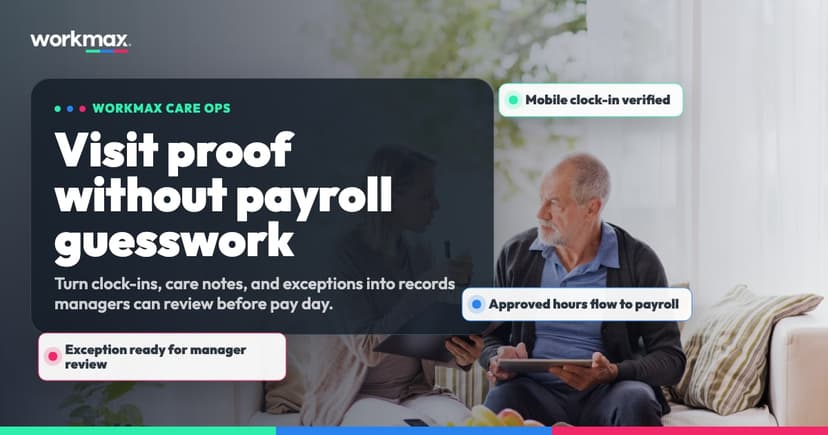
Workmax helps care providers connect care operations and payroll so the pay run starts from verified work, not disconnected spreadsheets.
With Workmax, care teams can bring together:
- rotas and scheduled visits;
- EVV and verified visit attendance;
- care tasks and visit outcomes;
- shift-linked timesheets;
- mileage and travel-time records;
- manager approvals;
- HMRC payroll;
- RTI submissions;
- payslips;
- audit trails.

That matters because care payroll problems usually start earlier than payroll. They start when a visit changes, a worker runs late, mileage is entered after the fact, a sleep-in includes waking time, or an enhancement is agreed but not linked to the approved record.
Workmax helps managers review the operational record, approve payroll-ready time, and keep evidence in one workflow. That makes it easier to spot missing approvals, unusual hours, mileage exceptions, and pay items before payroll is finalised.
Practical care payroll workflow
A strong care payroll process usually looks like this:
- Build the rota with planned visits, shifts, double-up calls, sleep-ins, and on-call cover.
- Capture actual attendance through EVV, timesheets, or visit records.
- Record visit changes, cancellations, no access, late starts, overruns, and emergency call-outs.
- Capture travel time and mileage between relevant visits.
- Approve care tasks, timesheets, mileage, sleep-in waking time, and exceptions.
- Check minimum wage risk before payroll is submitted.
- Run payroll, issue payslips, and submit RTI.
- Keep the audit trail for disputes, inspections, and payroll corrections.
The more that process is connected, the fewer surprises appear at the end of the month.
Common care payroll mistakes
Common mistakes include:
- paying only scheduled time when actual visit time changed;
- missing travel time between visits;
- approving mileage without route evidence;
- treating every sleep-in as identical even where waking time occurred;
- missing emergency call-out time;
- applying bank holiday rules manually and inconsistently;
- ignoring pay-impacting changes in visit notes;
- letting late timesheets bypass manager approval;
- failing to check deductions or expenses against minimum wage rules;
- keeping payroll evidence in too many places.
Most of these are process problems before they are payroll problems. The fix is usually better data flow, clearer policies, and stronger approval controls.
Related Workmax resources
- Domiciliary care software
- Care worker mileage and travel time payroll calculator
- Care agency wage to cost calculator
- CQC rostering: how to keep your care rota inspection ready
- Workmax payroll software
FAQ
What is care payroll?
Care payroll is payroll for care providers, including domiciliary care, home care, supported living, complex care, and other visit-based services. It often needs to account for visits, shifts, travel time, mileage, sleep-ins, waking nights, on-call duties, emergency call-outs, enhancements, overtime, and payroll compliance.
Why is care payroll harder than standard payroll?
Care payroll is harder because planned work and actual work can differ. Workers may move between clients, claim mileage, complete sleep-ins, respond to urgent calls, or work enhanced-rate shifts. Payroll needs to reflect what happened and remain compliant with minimum wage, PAYE, RTI, and internal policy requirements.
What is the UK minimum wage for care workers in 2026?
From 1 April 2026, the National Living Wage for workers aged 21 and over is £12.71 per hour. Younger workers and eligible apprentices have different minimum wage rates. Care providers should check the worker's age, apprentice status, working time, deductions, expenses, and pay reference period before assessing compliance.
Does travel time between care visits need to be paid?
Travel between care visits can create minimum wage risk. HMRC guidance says travelling between assignments at different places, where the worker is obliged to travel, is treated as working time for National Minimum Wage purposes. Ordinary home-to-work travel is treated differently, so providers should check the facts and keep clear records.
Does mileage count towards minimum wage pay?
Mileage reimbursement is usually an expense reimbursement, not wages. GOV.UK guidance says reimbursements for money a worker has spent on something to do with their job do not count as minimum wage pay. If a worker incurs employment-related costs that are not reimbursed, that can reduce pay for minimum wage purposes.
How should sleep-ins be handled in care payroll?
Sleep-ins should be handled according to the contract, the actual working arrangement, and what happens in practice. HMRC guidance says time when a worker is awake for the purposes of working is working time. Providers should record sleep-in periods, waking time, support delivered, and any escalation.
What records should care providers keep for payroll?
Care providers should keep records showing actual hours worked, contact time, travel time between appointments, waiting time where relevant, enhanced-rate hours, allowances, expenses, deductions, dates of birth, contracts, payroll approvals, payslips, and RTI submissions. GOV.UK guidance says employers must keep sufficient records to show that minimum wage is being paid for each pay reference period.
Can Workmax run care payroll and RTI submissions?
Yes. Workmax connects rotas, EVV, timesheets, mileage, approvals, HMRC payroll, RTI submissions, payslips, and audit trails so care providers can move from verified work to payroll with fewer manual corrections.