
Travel time is one of the easiest care payroll risks to underestimate.
For Birmingham care providers, the problem is practical before it is technical. Care workers may be moving between dense city routes, suburban visits, supported living services and cross-boundary work around Solihull, Sandwell, Walsall or the wider West Midlands.
Birmingham City Council's Economy and Place Strategy points to major development schemes and significant job creation ambitions. The city also has a large and varied labour market, which means care providers are competing for workers with retail, hospitality, health, logistics and other shift-based employers.
In that context, poor travel-time payroll is not only a compliance risk. It is a retention risk.
What counts as the payroll problem?
Travel time becomes a payroll issue when the rota, the actual visits and the pay run do not tell the same story.
Common examples include:
- carers paid for contact time only;
- back-to-back visits with unrealistic travel gaps;
- mileage reimbursed, but travel time not reviewed;
- visits changed during the day without payroll records updating;
- carers waiting between nearby visits with unclear rules;
- payroll checking planned rota hours instead of actual working records.
GOV.UK minimum wage guidance requires employers to look at pay and working hours across the pay reference period. If travel time that counts for minimum wage purposes is missed, the worker's effective hourly rate can fall below the legal minimum.
Birmingham-specific risks
Birmingham providers often manage a mix of dense and spread-out rounds. A carer might have visits clustered in one neighbourhood one day, then a more dispersed route the next.
That makes these checks important:
- Are travel assumptions realistic for the area?
- Are routes planned geographically, or just by available staff?
- Are visits often late because the rota ignores travel?
- Are mileage claims being used as a proxy for time?
- Can managers see travel gaps before payroll closes?
If the answer is "we would need to check messages", the evidence is too weak.
Use actual records, not only planned rotas
The planned rota is the starting point. Payroll should be based on approved records.
For each pay period, review:
- planned visit start and end times;
- actual arrival and departure times;
- travel time between visits;
- mileage submitted and approved;
- missed visits, no access and cancellations;
- manager-approved exceptions;
- corrections made after payroll cut-off.
This is especially important where carers work variable hours. Minimum wage risk is easier to miss when every week looks different.
Practical checklist for providers
Before payroll closes, ask:
- Have all visits been completed, cancelled or explained?
- Are travel gaps visible between visits?
- Are mileage claims matched to the route?
- Have late starts and overruns been reviewed?
- Have unpaid deductions or expenses been checked for minimum wage impact?
- Has a manager approved the exceptions?
- Can the provider explain the payslip if a carer asks?
You can model the risk with the care worker mileage and travel time payroll calculator.
How Workmax helps
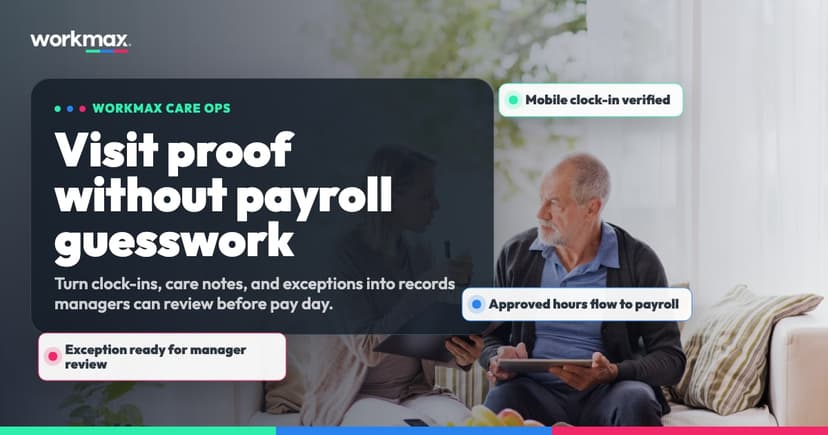
Workmax helps care providers connect rota, visit evidence, timesheets, travel time, mileage and payroll-ready approvals. That gives managers a cleaner route from care delivery to payday.
See Workmax home care payroll or explore the care operations tools.