
The paperwork is where many new hires stop feeling exciting and start feeling risky.
Offer accepted. Then the emails begin. Contract attached. Starter form attached. Bank details still missing. Right to work still waiting. Policy acknowledgement not returned. Payroll cut-off is close. Someone asks whether the laptop has been ordered. Nobody knows if the manager has actually confirmed the first-day plan.
That is not an onboarding strategy. It is a chain of small admin gaps that create stress, delays, and avoidable compliance mistakes.
For a small UK business, onboarding paperwork does not need to become a heavyweight HR project. It does need to become a clear workflow with the right triggers, owners, and checkpoints.
What automation should fix
The problem is usually not one big missing document. It is the handoff between tasks.
Manual onboarding tends to break in the same places:
- documents are sent, but not tracked;
- payroll details are collected too late;
- right-to-work evidence sits in someone’s inbox;
- managers assume HR has done something HR assumed the manager would do;
- the first day arrives before the record is complete.
A cleaner workflow does not remove judgment. It removes chasing.
The manual workflow versus the cleaner workflow
In a manual setup:
- A candidate accepts the role.
- Someone remembers to send paperwork.
- The employee replies in pieces.
- HR or the owner manually checks what is still missing.
- Payroll, line manager, and operations all work from slightly different information.
In a cleaner automated workflow:
- Offer accepted triggers the onboarding checklist.
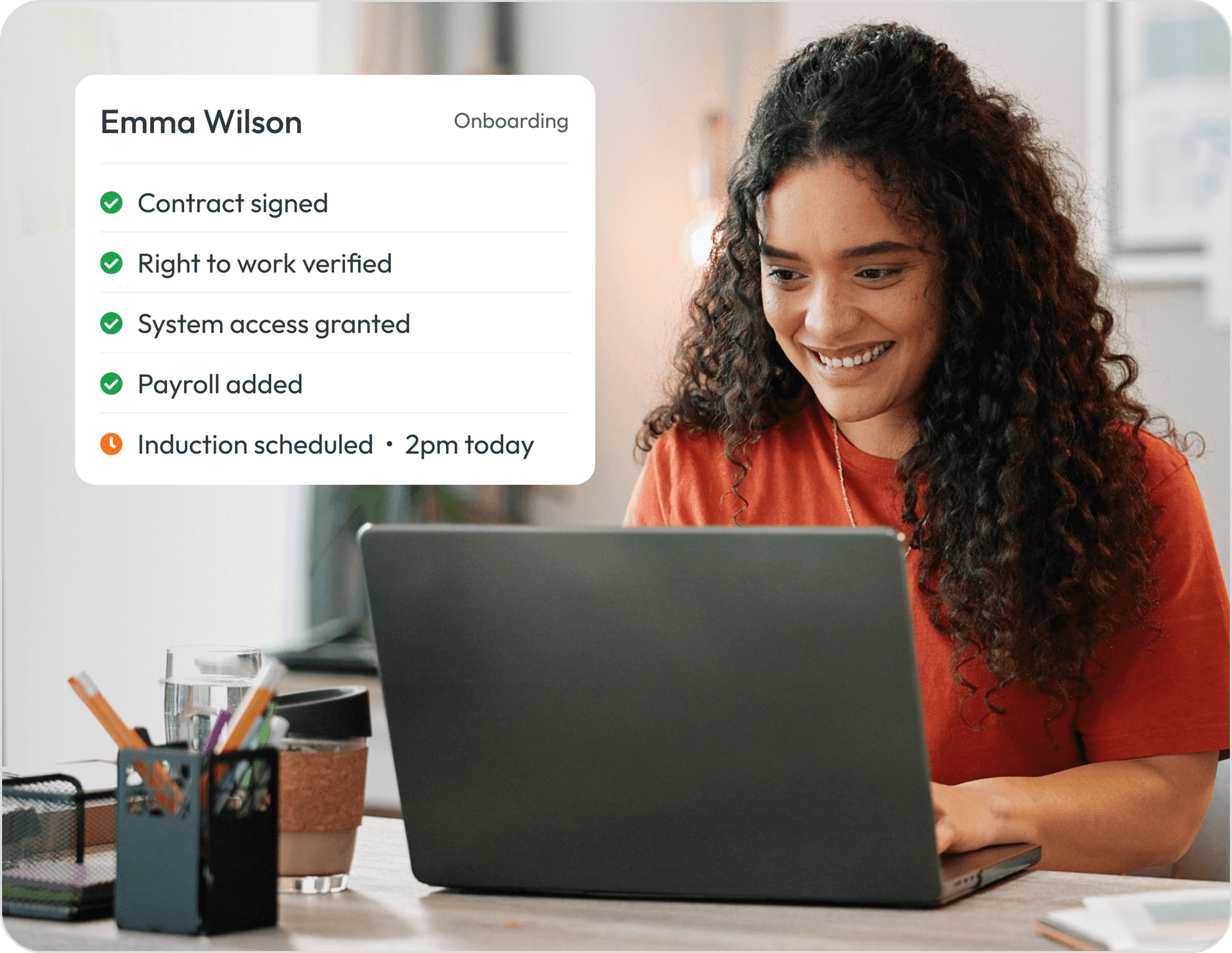
- Contract, starter form, bank details, and policy acknowledgements are issued in one flow.
- Right-to-work steps are assigned and tracked.
- Missing items create reminders automatically.
- Payroll and manager readiness are checked before the first day.
That is the real point of HR process automation for SMEs. Not “AI HR transformation”. Just fewer moving parts going missing.
Step 1: Decide the minimum onboarding pack
Before you automate anything, decide what every new starter must complete.
For most UK SMEs, that includes:
- contract or written terms;
- personal details;
- bank details;
- tax starter information;
- emergency contact details;
- right-to-work check handoff;
- key policies or handbook acknowledgement;
- role-specific first-day instructions where needed.
If the list changes every time, the workflow will never feel reliable.
Step 2: Trigger onboarding from one event
The cleanest trigger is offer acceptance.
That should start the same baseline sequence every time:
- create employee record;
- issue paperwork;
- assign document tasks;
- assign manager tasks;
- set target completion dates before the start date.
This avoids the common small-business problem where onboarding begins only when someone finds time to do it.
Step 3: Separate employee tasks from internal tasks
This matters more than most teams realise.
Employee-facing tasks:
- complete personal details;
- upload documents;
- confirm bank information;
- read and acknowledge policies.
Internal tasks:
- review right-to-work evidence;
- confirm payroll setup;
- check the role, pay, and holiday details are correct;
- confirm first-day readiness.
If you mix these together in one informal checklist, ownership becomes fuzzy and delays stop being visible.
Step 4: Make missing items visible before day one
Automation is useful when it reveals what is incomplete early enough to fix it.
You want a pre-start check that answers:
- has the contract been returned;
- are payroll details complete;
- has right-to-work evidence been reviewed or escalated;
- are required documents stored in the employee record;
- does the manager know the start date and first-day plan.
That check should happen before the first day, not during it.
Step 5: Keep the audit trail in one place
Onboarding paperwork should not end up across five systems.
The real operational win is not just sending forms faster. It is being able to answer these questions quickly later:
- what was sent;
- what was returned;
- when was it approved;
- where is the document now;
- who still needs to do something.
That matters for compliance, payroll, and simple day-to-day confidence.
Worked example
A 22-person construction company hires a site administrator. In the old process, the director emails a contract, the office manager chases bank details, payroll receives starter information late, and right-to-work evidence sits in email until the employee’s second week.
In the cleaner workflow:
- offer acceptance creates the employee record;
- the contract, personal details form, bank details request, and policy acknowledgements are issued together;
- right-to-work review is assigned internally with a due date;
- payroll gets the starter details once the required fields are complete;
- a pre-start checklist flags any missing items two days before the employee starts.
The result is not just speed. It is a quieter first week with fewer interruptions.
Common mistakes
- Sending paperwork manually with no task status.
- Treating right-to-work as a separate loose process rather than part of onboarding.
- Waiting until payroll cut-off to discover bank details or starter information are missing.
- Relying on one person’s memory to know whether the file is complete.
- Overcomplicating the workflow with edge cases before the standard path works.
Where small teams usually feel the biggest benefit
The biggest improvement is rarely “time saved per document”. It is reduced context-switching.
Managers stop chasing forms.
Payroll stops asking for missing details at the last minute.
Owners stop acting as the backup task tracker.
New starters get a more competent first impression.
That is how onboarding automation reduces burnout. It lowers the number of small loose ends that keep landing back on the same person.
How Workmax helps
Workmax helps UK SMEs keep employee records, onboarding tasks, documents, policy acknowledgements, and payroll handoffs in one workflow so a new starter does not move through contracts, inboxes, spreadsheets, and memory as separate systems.
If onboarding paperwork is already causing drag, start with HR software for UK employers and pair it with the new employer compliance checklist so the first-day workflow and the employer setup steps stay joined up.