
PATHWAY 03 · CARE DELIVERY
How to plan and deliver domiciliary care safely
A practical guide to care plans, rota control, carer matching, EVV, missed visits, care records and manager approval for domiciliary care providers.
Applies to: UK operational guidance. Apply the regulator and commissioning requirements relevant to each service.
- Practical guide
- 30 min read
- Reviewed 20 July 2026
- 6 official sources checked
What this guide covers
- Assess and agree the care
- Create and approve the care plan
- Translate the plan into visits
- Schedule a suitable worker
Quick answer
Start with the person’s assessed needs, preferences and agreed outcomes—then translate them into safe, deliverable visits.
Safe domiciliary care starts before the carer reaches the door. The provider needs to translate assessed needs into a clear care plan, schedule the right worker with enough travel time, and make risks and expected outcomes visible before the visit begins.
The visit record should then show what actually happened: arrival and departure, care delivered, tasks not completed, changes in need and any action taken. Routine factual records become part of the care history; managers review specified exceptions, confirm follow-up and separately approve payable time without rewriting the worker’s account.
Person-centred foundation
Begin with assessed needs and an agreed care plan
Every scheduled task should trace back to an assessed and agreed need. The person—or someone lawfully acting for them—should be involved in planning and review, with consent and capacity considered for the decisions being made.
- Needs assessment and desired outcomes
- Preferences, routines and communication needs
- Consent and mental-capacity considerations
- Relevant health conditions and changes to monitor
- Medication-support requirements
- Moving-and-handling requirements
- Nutrition and hydration needs
- Environmental and lone-working risks
- Emergency contacts and escalation arrangements
- Missed-visit contingency
- Review date and triggers for an early review
- How the person wants to participate in decisions
Translate the plan
Turn the care plan into a practical visit brief
The brief should give the worker enough current information to deliver the agreed care safely without inventing tasks or reconstructing instructions from messages.
- Why the visit is required and the outcome it should support
- Tasks that are authorised—and tasks that must not be performed
- Earliest and latest acceptable arrival time
- Expected duration and whether timing is safety-critical
- Required competencies and whether one or two workers are needed
- Medication, nutrition or other time-dependent requirements
- Access instructions and key-safe controls
- Known risks and person-specific preferences
- What the worker must record
- What requires immediate escalation
- What happens if the visit is late or cannot be delivered
- Who owns unresolved actions after the visit
Availability is not enough
Match a suitable worker and protect continuity
A free space in a rota does not prove a safe match. Use a consistent team where practicable and tell the person in advance when an unfamiliar worker will attend.
- Training and assessed competency
- Experience with the person’s needs
- Moving-and-handling requirements
- Medication competency
- Language and communication requirements
- Gender or cultural preferences where relevant
- Continuity and familiarity with the person
- Door-to-door travel from the previous visit
- Working-time and rest constraints
- Lone-working risks
- Need for shadowing or an introduction
- Backup suitability if the planned worker becomes unavailable
Hard rota control
Build a rota that works at the front door
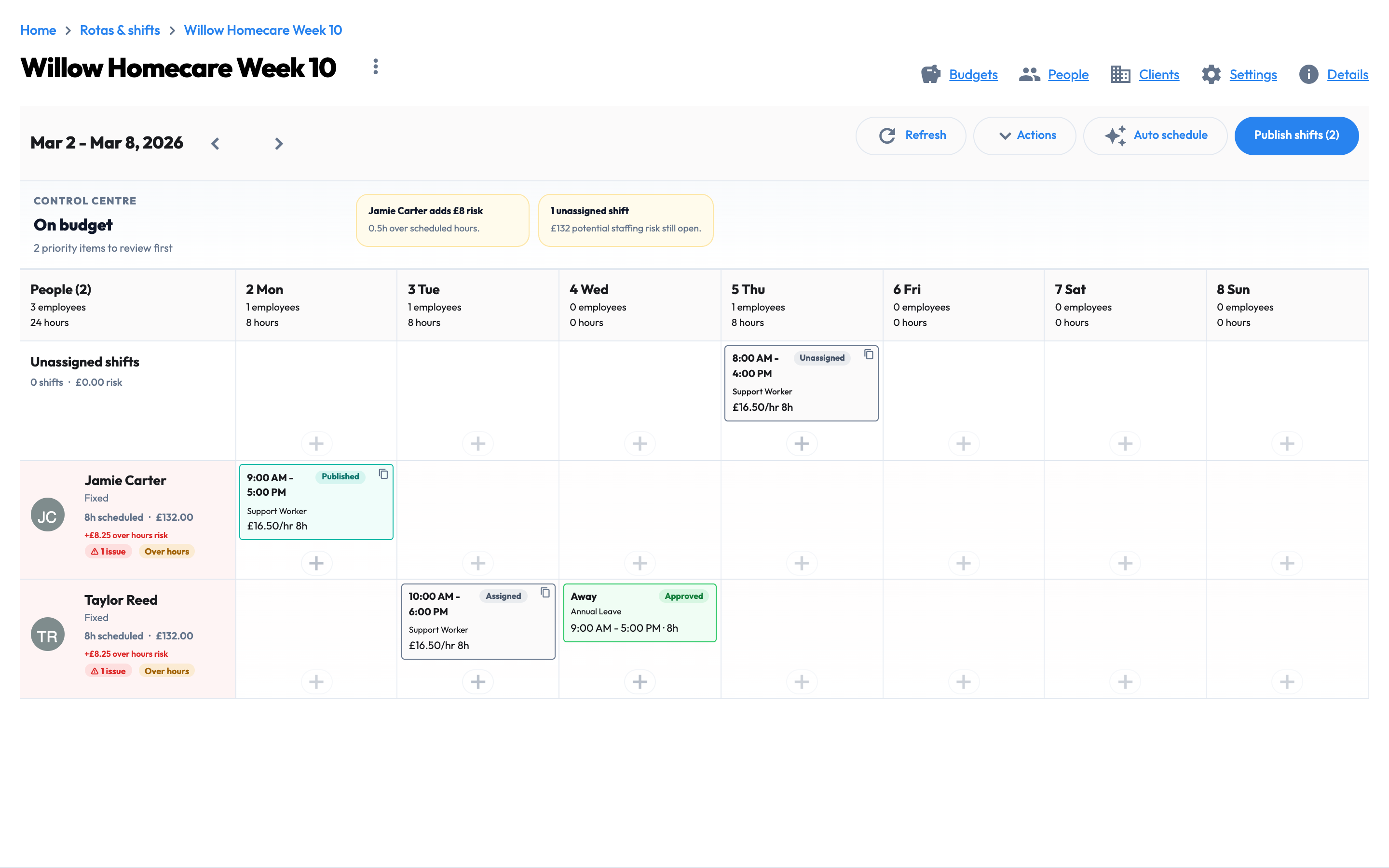
Visits can fail without overlapping on screen. Test the complete journey and the consequence of delay for each person before publishing.
- Actual travel time at the scheduled time of day
- Parking, building access and walking time
- Collecting or returning keys
- Rural routes and public-transport limitations
- Likely traffic and weather disruption
- The previous visit overrunning safely
- Required breaks and working-time constraints
- Medication, nutrition or other harm caused by delay
Publish based on door-to-door feasibility, not just visit duration.
Dynamic safety check
Pause, check, deliver and record
The current plan remains the authority, but the worker should complete a short dynamic check because the person and environment may have changed since the visit was scheduled.
- 01Confirm the correct person and visit.
- 02Check whether anything material has changed.
- 03Obtain or confirm consent before providing care.
- 04Review immediate environmental and lone-working risks.
- 05Follow the current care plan and authorised visit brief.
- 06Stop and escalate when a task is outside the plan or the worker’s competence.
- 07Record care, outcomes and relevant observations at the time or as soon as practicable.
- 08Leave the person safe, informed and aware of any follow-up.
Person-specific backup plan
Give missed and late visits their own response framework
The threshold and response should reflect the person-specific harm that delay could cause. Every person should have a usable backup plan, not only a generic escalation policy.
| Control | Question to answer |
|---|---|
| Late threshold | At what point is this visit considered late? |
| Risk level | What harm could delay cause for this person? |
| Detection | How will the office know the worker has not arrived? |
| Contact | Who contacts the worker and the person receiving care? |
| Backup | Who can safely deliver the visit instead? |
| Escalation | When must a manager, family member, commissioner or emergency service be contacted? |
| Recording | How will decisions, communications and outcomes be documented? |
| Review | Who investigates the cause and prevents recurrence? |
Attendance is one signal
EVV can evidence attendance—not the quality of care by itself
Electronic visit verification may show that a worker attended a location at a time. Complete care evidence combines attendance with what happened, what changed and what follow-up was owned.
- Worker identity and attendance evidence
- Arrival, departure and visit timing
- Tasks completed, omitted or refused
- Outcomes and relevant observations
- Medication records where applicable
- Exceptions and escalations
- The person’s experience and feedback
- Visible manager follow-up and plan review
Owned exceptions
Classify exceptions, notify the right person and define closure
For each category, define who is notified, how quickly they must respond, the immediate safety action and the evidence required before the exception is closed.
Delivery exceptions
- Late arrival
- Missed or shortened visit
- No access
- Essential care incomplete
- Unplanned worker
Care exceptions
- Care refused
- Medication omitted or unavailable
- Fall, injury or deterioration
- Nutrition or hydration concern
- Safeguarding or capacity concern
Record exceptions
- Missing or late note
- Contradictory information
- Unexplained time change
- Care without attendance evidence
- Correction without an audit trail
Who this guide is for
Use this pathway when you own or oversee the daily system for planning, delivering and reviewing home-care visits.
- Registered managers and nominated individuals
- Care coordinators, rostering teams and field supervisors
- Quality, compliance and operations leads
- Providers replacing paper, spreadsheets or disconnected care systems
Decision process
A complete care cycle from assessment to improvement
Each stage should preserve the person’s agreed care and leave enough information for the next person to act without reconstructing decisions from messages.
- 01
Assess and agree the care
Assess needs, preferences, risks, consent and desired outcomes with the person or someone lawfully acting for them.
- 02
Create and approve the care plan
Document agreed outcomes, authorised support, risks, contingency arrangements and review triggers.
- 03
Translate the plan into visits
Define purpose, tasks, timing, duration, competence, records and escalation for every visit.
- 04
Schedule a suitable worker
Protect continuity, match competence and preferences, and test realistic door-to-door travel.
- 05
Brief the worker
Make the current care plan, visit brief, changes, access information and backup arrangements available.
- 06
Deliver and record the visit
Confirm consent and immediate safety, provide authorised care, and create an attributable contemporaneous record.
- 07
Respond to exceptions immediately
Protect the person first, notify the right people and record decisions, communications and ownership.
- 08
Review outcomes and update the plan
Use changes, refusals, incidents and feedback to trigger review and communicate approved plan changes.
- 09
Monitor quality across the service
Sample records and analyse continuity, lateness, missed visits, exceptions, outcomes and recurring causes.
Practical checklist
Controlled-visit checklist
Use this before publishing the rota and again when reviewing whether the visit cycle worked as intended.
- Every visit comes from a current care plan and has a clear purpose.
- The assigned worker has the required skills, checks and service knowledge.
- Continuity, preferences, language, gender and compatibility have been considered.
- Travel time is realistic and does not create overlapping commitments.
- Risks, access instructions, tasks and escalation contacts are visible.
- Unassigned, double-up and time-critical visits have an accountable owner.
- Workers receive changes and managers can see whether they were acknowledged.
- Late, missed and no-access alerts have response and escalation rules.
- Each visit traces back to an assessed need, preference or agreed outcome.
- The person-specific backup plan is visible to the people expected to use it.
- Workers know factual records are attributable and corrections require a visible audit trail.
- Plan-review triggers and ownership of follow-up actions are defined.
Records that should tell the visit story
- Current care plan, risk assessments and review history
- Published rota, assignments, changes and acknowledgement history
- Arrival, departure and available location evidence
- Task outcomes, daily notes and medicines-support records
- Missed, late, no-access, shortened and declined-visit records
- Incidents, safeguarding escalations, family or professional contacts and follow-up
- Manager review, corrections and approval history
- Care-plan review decisions, approved changes and communication history
Where visit control commonly breaks
The rota becomes the evidence
A scheduled visit only shows intent. It does not prove arrival, care delivered or how an exception was handled.
Care instructions are out of date
Workers act from an old plan or informal message because review changes did not reach the live visit brief.
Travel is treated as empty space
Back-to-back visits look covered on screen but cannot be delivered safely in the real geography.
Exceptions live in private messages
The office resolves the immediate problem but leaves no reliable record of the decision and follow-up.
Payroll approval happens too early
Hours move into pay before shortened, missed or disputed visits have been investigated.
The factual record is silently rewritten
A manager changes the worker’s account rather than adding an attributable correction, review or follow-up record.
Check the source
Official guidance to use alongside this guide
Check current regulator, commissioning and statutory guidance for the people and services you support.
- CQC Regulation 9: person-centred careAssessment, involvement, agreed plans, review and care that reflects needs and preferences.
- NICE: plan for missed or late visitsPerson-specific backup planning, communication, alternative arrangements and monitoring.
- NICE: consistent team of home-care workersWhy continuity supports safety, confidence and understanding of needs and preferences.
- CQC regulations for service providers and managersThe fundamental standards and regulatory requirements for services in England.
- NICE guidance: home care for older peopleRecommendations covering planning, delivery, continuity and review of home care.
- CQC: medicines in adult social careCurrent regulator guidance for medicines support and records.
Continue learning
Supporting guides planned for this pathway
These focused guides will expand the operational decisions introduced here.
- Arrange emergency staff cover
- How to create and review a domiciliary care plan
- Risk assessments for home-care visits
- Domiciliary care rota planning and carer matching
- Managing missed, late and no-access visits
- Electronic visit verification explained
- Lone-working safety and changes during a visit
A RESTRAINED WORKMAX CONNECTION
Keep the plan, visit evidence and manager decision together
Workmax connects care plans, rotas, visit verification, task outcomes, exceptions and approved time. It supports a clearer operational record; it does not replace professional judgement or provider responsibility.
Continue through the hub