
CARE DELIVERY · EMERGENCY COVER
How to arrange emergency staff cover in domiciliary care
An eight-step procedure for arranging emergency domiciliary care cover, prioritising visit risk, checking worker suitability and recording escalation decisions.
Applies to: UK operational guidance. Apply the care plan, regulator, commissioner, safeguarding and emergency requirements relevant to each person and service.
- Practical guide
- 18 min read
- Reviewed 30 July 2026
- 5 official sources checked
What this guide covers
- Confirm the actual outcome
- Follow up with the person and workers
- Classify the causes
- Complete required reporting
Quick answer
Confirm the gap, rank affected visits by risk and keep accountable ownership until every person has a safe, recorded outcome.
If a care worker becomes unavailable, identify every affected visit immediately and prioritise the response by the harm that delay or omission could cause. A free worker is not automatically a safe replacement: competence, familiarity, travel, fatigue, working hours, restrictions and the person’s current care plan all matter.
Keep one accountable coordinator on the gap until every visit is safely covered, rescheduled with an assessed response, or escalated under the person’s contingency plan and the provider’s procedures. Record the options considered and what actually happened, not only the final rota edit.
If you have an uncovered visit now
Arrange emergency cover in eight controlled steps
Use this sequence as soon as a worker reports unavailable or a live round breaks down. Protect people first; resolve payroll and cost consequences after the immediate care risk is controlled.
- 01
Confirm the exact coverage gap
Confirm whether the worker is unavailable for the whole round or part of it, their last completed visit, their current location where relevant, and whether any immediate welfare or lone-working response is required.
- 02
Identify every affected visit
List planned start windows, required tasks, double-up dependencies, travel sequence, access information and the current state of each visit. Do not rely on a worker’s memory or a message thread.
- 03
Prioritise person-specific risk
Use the care plan, risk assessment and contingency arrangements to identify medication, nutrition, moving-and-handling, safeguarding and other time-critical consequences.
- 04
Find suitable cover
Check available employed or bank workers first under the provider’s procedure, then an approved agency arrangement where needed. Availability never replaces competence, deployment or suitability checks.
- 05
Test whether the replacement round is deliverable
Check door-to-door travel, access, breaks, working hours, rest, fatigue, other employment, driving feasibility and the effect on every visit already assigned to the replacement worker.
- 06
Brief the worker and communicate changes
Give the replacement current care instructions, risks, access details and escalation contacts. Tell the person or their representative about a changed worker or time in the agreed way and notify others required by the care plan or contract.
- 07
Escalate care that remains at risk
Activate the person-specific backup plan and provider escalation tree. Contact the manager, representative, commissioner, safeguarding route, health professional or emergency service when the assessed circumstances require it.
- 08
Monitor, record and follow up
Confirm arrival and outcome rather than assuming reassignment solved the gap. Record the decision-maker, options, risks, communications, escalation and actual result, then review causes and prevention actions.
Match the response to the event
Four emergency-cover scenarios need different controls
The same eight-step discipline applies, but the first facts and escalation pressure change with the event.
Short-notice sickness before visits begin
Confirm the entire affected round before reassigning individual calls. Separate the sickness and pay record from the care-delivery decision, then test whether spreading visits across several workers creates new travel or continuity risks.
A worker becomes unavailable mid-round
Establish the last completed visit, current outstanding tasks and whether anyone may already be waiting. Check the worker’s welfare where appropriate, alert the coordinator immediately and monitor replacement arrival for the remaining calls.
Multiple simultaneous gaps
Move to a service-level response with one decision lead, a live affected-visit list and agreed update cadence. Rank harm across the complete caseload instead of allowing each coordinator to compete for the same available workers.
No suitable internal cover is available
Use approved bank or agency arrangements where they can provide a suitably checked, competent and briefed worker. If safe cover still cannot be secured, activate contingency and escalation procedures rather than assigning an unsuitable person or leaving the gap silent.
Prioritise person-specific harm
Prioritise the consequence of delay—not who complains first
This table is a prompt, not a universal scoring formula. The current care plan and person-specific risk assessment determine the actual response.
| Care need | Risk if delayed or missed | Cover check |
|---|---|---|
| Medication or other time-critical care | A missed dose, incorrect timing, deterioration or avoidable clinical escalation. | Required medicines competence, authorised task, timing window and escalation instructions. |
| Moving and handling | Unsafe transfer, immobility, pressure risk, toileting delay or injury. | Current moving-and-handling plan, equipment competence and whether two workers are required. |
| Double-up visit | One worker attempts an unsafe task or essential care cannot proceed. | Both suitably competent workers, coordinated arrival and a clear instruction not to proceed alone. |
| Meals and hydration | Missed food, fluids or monitoring, with greater risk for people unable to prepare or request help. | Dietary plan, swallowing or diabetes instructions, preparation tasks and latest safe timing. |
| Safeguarding concern or known deterioration | A warning sign is not observed, reported or acted on. | Current concern, observation and reporting instructions, and named safeguarding or clinical escalation route. |
| Person unable to summon help | The person may remain without essential support and cannot alert the provider. | Priority contact, welfare-check route, access arrangements and person-specific contingency plan. |
| Time-sensitive personal care | Distress, loss of dignity, skin damage, continence problems or disruption to an essential routine. | Latest acceptable time, preferences, authorised tasks and consequences recorded in the care plan. |
Name what actually happened
Uncovered, late and missed are not interchangeable
Keep the operational state current as events change. Each state creates different communication, escalation and quality records.
| State | Meaning | Record and response |
|---|---|---|
| Uncovered visit | No suitable worker is currently assigned to deliver the planned visit. | Keep an accountable owner, options considered, risk priority, next review time and escalation status until there is a safe outcome. |
| Late or rescheduled visit | The visit remains planned, but its expected timing has changed. | Record the assessed effect of delay, agreement or notification, revised time, interim safety action and whether the replacement arrived. |
| Missed visit | The planned care did not occur within the response accepted under the care plan and provider procedure. | Protect the person immediately, record the omission and consequences, notify required people, escalate or report where required, and review the cause. |
A legal-hours check is not a safety decision
Check capacity, fatigue and the real journey
Working Time Regulations checks may identify limits, but a calculation cannot prove that a deployment is safe. The coordinator must consider the worker, the work, the route and the people affected.
Passing a working-hours calculation does not establish that a worker is rested, competent, suitably briefed or able to drive and deliver the round safely.
- Hours already worked and the full proposed finish time
- Daily and weekly rest, breaks and any applicable exceptions
- Night-work pattern and fatigue
- Other employment or work disclosed by the worker
- Door-to-door travel, parking, access and likely delay
- Driving fitness, vehicle arrangements and weather
- Existing visits displaced or compressed by the change
- Task complexity, emotional load and supervision needs
Prepare before the gap happens
Build the cover system before the phone rings
A prepared provider can move quickly without dropping the checks that protect people and workers.
- A named in-hours and out-of-hours decision and escalation tree
- Current worker availability, restrictions and contact preferences
- Up-to-date training, competency, checks and deployment status
- Person-specific visit priorities and missed-visit contingency arrangements
- Approved bank and agency contacts with agreed onboarding and briefing controls
- A live view of unassigned, double-up and time-critical visits
- Communication templates that still allow person-specific information
- A defined record for decisions, options, risks, communications and outcomes
Who this guide is for
Use this guide when you coordinate provider-controlled home-care visits and need to respond to an unexpected staffing gap.
- Registered managers and nominated individuals
- Care coordinators and rostering teams
- Out-of-hours duty managers and field supervisors
- Operations, quality and safe-staffing leads
Decision process
Close the loop after the immediate gap
Once the person is safe, review whether the response exposed a weakness that could recur.
- 01
Confirm the actual outcome
Compare the final visit evidence with the planned response, including arrival, duration, care delivered and any unmet need.
- 02
Follow up with the person and workers
Check the person’s experience, worker welfare and whether the replacement had the information and competence needed.
- 03
Classify the causes
Separate absence, availability, competency, travel, communication, system and management-control causes.
- 04
Complete required reporting
Finish incident, safeguarding, commissioner, regulator, employment and payroll actions required by the circumstances.
- 05
Strengthen the contingency
Update person-specific backup plans, worker deployment data, escalation ownership or approved cover arrangements.
- 06
Monitor recurrence
Review uncovered, late and missed visits for patterns rather than treating every gap as an isolated event.
Practical checklist
Emergency-cover decision checklist
Use this before confirming a replacement worker and again when closing the event.
- Every affected visit and its current state is visible.
- The risk priority comes from the person’s current plan and circumstances.
- The proposed worker has the required checks, competence and authorised scope.
- Continuity, preferences, communication needs and known restrictions were considered.
- Travel and access make the revised round deliverable.
- Hours, rest, fatigue, other employment and driving feasibility were checked.
- The replacement worker received current care and escalation information.
- The person or representative was informed in the agreed way.
- Unresolved risk was escalated through the correct route.
- Arrival and actual outcome were monitored.
- The decision-maker and options considered were recorded.
- Follow-up and prevention actions have a named owner.
Keep the complete decision chain
- Who identified the gap, when it began and every visit affected
- Who made and authorised the cover decision
- Person-specific risks and priority assigned to each visit
- Workers and other options considered, including why they were accepted or rejected
- Competence, checks, restrictions, availability and suitability evidence
- Working hours, rest, fatigue, other-employment, travel and driving considerations
- Care-plan, risk, access and escalation information given to the replacement
- Communications with the person, representative, workers, commissioner and other relevant parties
- Escalation decisions, advice received and interim safety action
- Actual arrival, care outcome, unmet need, incident and follow-up
- Rota, visit and payroll adjustments kept distinct and attributable
Do not do this
Assign purely by availability
A free space in someone’s day does not prove competence, suitability, safe capacity or a deliverable journey.
Ignore travel and displaced visits
Adding one call may make the replacement worker late for several people or create an unsafe driving and fatigue burden.
Assume familiarity equals competence
Knowing the person or service does not authorise a worker to perform medication, moving-and-handling or other competency-controlled tasks.
Silently shorten, combine or move visits
A rota edit cannot replace assessment, agreement or notification, and a record of the effect on the person.
Treat legal working hours as proof of safety
A worker can remain within a calculated limit and still be too fatigued, insufficiently briefed or unable to complete the route safely.
Leave uncovered care without escalation
Keep named ownership and activate the contingency plan; do not allow a gap to disappear into messages or shift handover.
Stop monitoring after reassignment
Confirm arrival and care outcome. A new name on the rota does not prove that the visit happened.
Check the source
Official guidance to use alongside this guide
Check current requirements and apply the person’s care plan, risk assessment and local provider and commissioner procedures.
- CQC Regulation 18: staffingSufficient suitably qualified, competent, skilled and experienced staff, including procedures for emergency cover.
- NICE quality statement: plan for missed or late visitsPerson-specific backup planning, communication, risk assessment, monitoring and commissioner review.
- NICE home-care recommendationsContinuity, changed workers, contingency plans and prompt action when visits are missed or late.
- CQC Regulation 12: safe care and treatmentAssessment and mitigation of risks, competence and action when safety is threatened.
- HSE: managing fatigueFatigue risk, working patterns and why compliance with hours alone does not remove safety risk.
Continue learning
Continue with the connected controls
Emergency cover sits between workforce readiness, safe visit delivery and evidence of what actually happened.
A RESTRAINED WORKMAX CONNECTION
See the information needed to make and record the decision
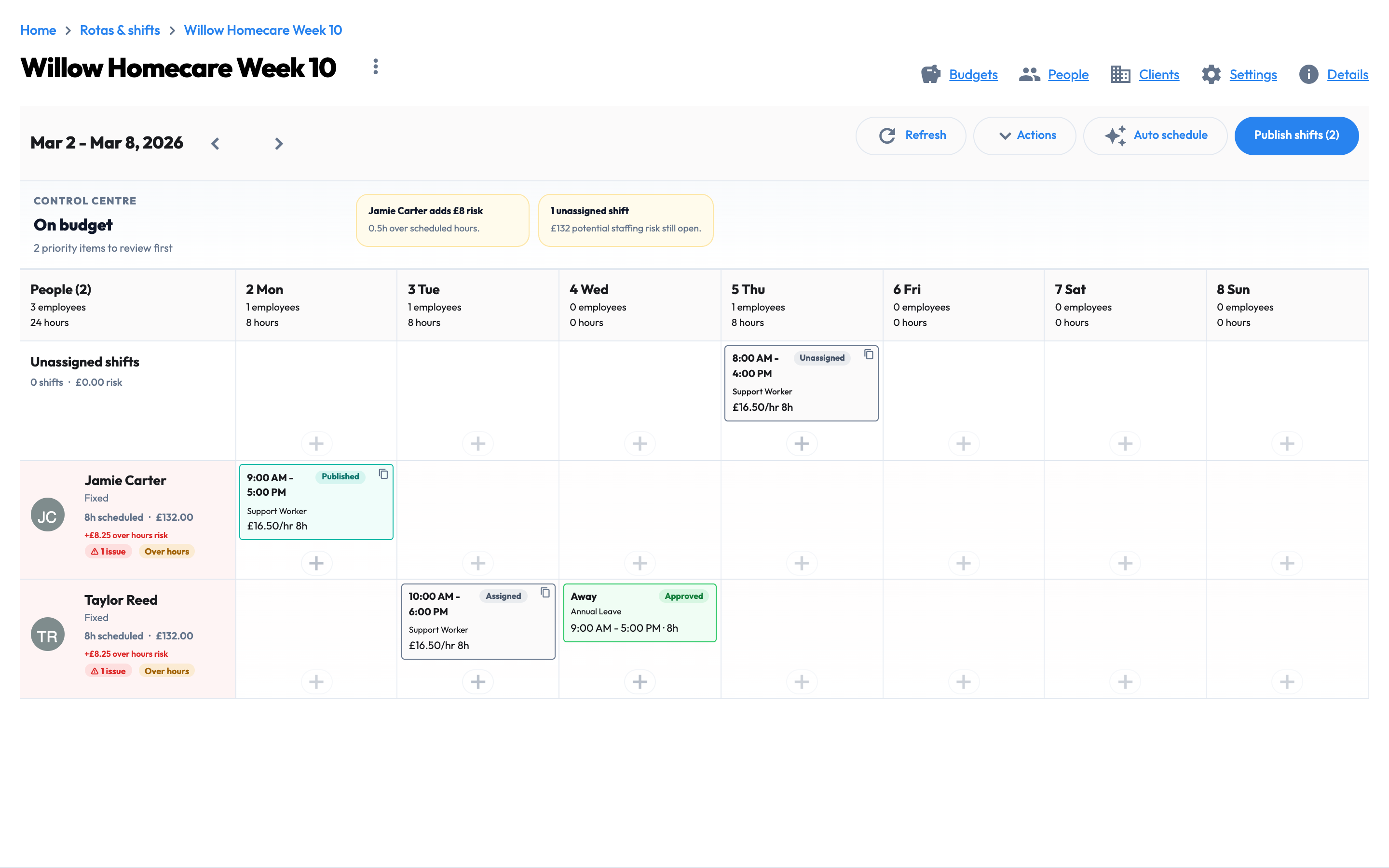
Emergency cover still requires human judgement. Workmax helps coordinators see the operational information needed to make and record that judgement, including availability, unassigned work, competency context, rota changes, visit status, exceptions and audit history. It does not select the safest worker automatically, replace professional judgement or guarantee compliance.
Continue through the hub