
PATHWAY 04 · CARE WORKFORCE
How to manage a domiciliary care workforce
Practical guidance on care-worker availability, absence, working time, safe staffing, supervision, records and retention for domiciliary care providers.
Applies to: UK workforce guidance. Confirm the employment terms and regulator requirements that apply to your organisation and location.
- Practical guide
- 10 min read
- Reviewed 3 August 2026
- 8 official sources checked
What this guide covers
- Forecast care demand
- Confirm current deployability
- Capture availability and absence
- Calculate usable capacity
Quick answer
Know who is deployable, how much safe capacity you have and where the next staffing risk will appear.
Care workforce management means knowing who is deployable, how much safe capacity the service has and where the next staffing risk will appear. A name marked active or available is not enough: eligibility, readiness, capacity and suitability are separate decisions.
By the end of this pathway, you will be able to forecast the capacity your service needs, identify who is currently safe to deploy, monitor hours and workload, provide effective supervision and act before staffing pressure affects care. Recruitment owns the initial checks and authorisation; this pathway owns their continuing operational status.
Four separate dimensions
An active employee status cannot answer four different questions
Keep each dimension visible. A worker can be eligible but not competent, competent but unavailable, within contracted hours but fatigued, or generally suitable but restricted for a particular person or task.
| Dimension | Decision question |
|---|---|
| Eligibility | Is the person legally and contractually permitted to work, and are follow-up checks current? |
| Readiness | Are required training, competencies, documents and deployment authorisations current? |
| Capacity | Can they take this work without unsafe hours, insufficient rest, overload or conflicting commitments? |
| Suitability | Are they appropriate for this person, visit, location and required tasks? |
Begin above the rota
Forecast the work before measuring worker availability
Build demand by time, place and skill. Include planned packages and predictable non-visit work so a reassuring total-hours figure does not hide an 8am Sunday gap.
- Contracted and planned care hours
- Visit timing and geographic distribution
- Double-handed and continuity-sensitive visits
- Required competencies and restrictions
- Morning, evening, weekend and bank-holiday peaks
- Annual leave, sickness assumptions and vacancies
- Travel, training, supervision and administration
- On-call and emergency cover
- New packages due to start
- Packages likely to increase, reduce or end
Staffing sufficiency must be tested by time, place and skill—not only by total headcount.
A realistic capacity calculation
Calculate usable capacity, not empty rota hours
Start with genuinely available working time across all known work, then deduct commitments and constraints. Review daily and weekly rest, average hours, night work, split shifts, waiting, other employment, overtime, fatigue and whether extra hours were agreed.
Available working time, less
- Existing visits
- Travel between assignments
- Genuine uninterrupted breaks
- Training and supervision
- Approved leave and known absence
- Known restrictions and reasonable adjustments
- Work for another employer where known
- Fatigue and rest constraints
Usable capacity is the time that remains safe, lawful, agreed and suitable—not every blank space in the rota.
Different risks, different cadences
Run workforce controls when the risk changes
Before each rota is published
- Deployability and competency status
- Availability and agreed hours
- Working time, rest and travel feasibility
- Restrictions and suitable assignments
Daily
- Sickness and absence
- Unplanned overtime and unsafe workload
- Worker welfare concerns
- Emergency reassignment effects
Weekly
- Coverage gaps and overtime concentration
- Repeated short-notice changes
- Expiring evidence
- Uneven or insufficient contracted hours
Monthly or periodically
- Supervision, appraisal and training status
- Sickness, turnover and retention patterns
- Continuity, complaints and incidents
- Vacancy and recruitment requirements
Event-triggered
- Safeguarding allegation or serious complaint
- Medication error or failed competence assessment
- Health, capability, driving or right-to-work change
- Return from extended absence
Support and development
Use supervision to review work, wellbeing and competence
Frequency should follow risk and need, not only a standard interval. New workers, returners and people involved in an incident may need additional support and observation.
- Wellbeing, workload and travel burden
- Experiences with people receiving care
- Safeguarding and professional boundaries
- Complaints, incidents and near misses
- Record quality and reliability
- Confidence, competence and observations
- Training and career development
- Actions, owners and dates
- Restrictions or reassessment required
- Follow-up on previous actions
Workforce stability
Treat workforce stability as a care-quality control
Use patterns to understand why people stay, struggle or leave. Compliance status alone cannot show whether the workforce will remain sufficient.
- Turnover and new-starter retention
- Exit reasons and employee feedback
- Sickness, burnout and fatigue
- Overtime concentration and cancelled shifts
- Predictability of working hours
- Travel burden and continuity
- Supervision quality and recognition
- Training and career progression
- Pay errors and delayed expenses
- Relationships with people receiving care
Safe workforce exits
Remove work and access safely when status changes
Suspension, restriction and leaving are operational safety events as well as HR processes. Recalculate capacity and protect continuity immediately.
- Remove or restrict future assignments
- Reallocate visits and notify accountable managers
- Restrict system and record access
- Recover keys, devices and identification
- Preserve employment and care records
- Process final pay and accrued holiday
- Record exit feedback and re-employment position
- Make safeguarding or regulatory referrals where required
- Review the effect on workforce capacity
- Confirm every action, owner and completion date
Who this guide is for
Use this pathway when workforce information and rota decisions are managed by different people or systems.
- Registered managers, operations managers and service leads
- HR, recruitment and compliance teams
- Care coordinators and rostering teams
- Field supervisors responsible for supervision and competency
Decision process
Run a complete workforce-control loop
Path 3 maintains clean worker and capacity data; the care-delivery pathway uses it for individual visit assignments.
- 01
Forecast care demand
Quantify required hours, timing, place, skills, travel and non-visit activity.
- 02
Confirm current deployability
Monitor follow-up checks, training, competence, restrictions and changes since initial authorisation.
- 03
Capture availability and absence
Maintain agreed patterns, leave, sickness, adjustments and return-to-work actions.
- 04
Calculate usable capacity
Deduct work, travel, breaks, learning, leave and restrictions while considering rest and fatigue.
- 05
Match skill, continuity and location
Prepare reliable worker options for coordinators without making the visit assignment here.
- 06
Monitor workload and delivery
Review overtime, travel, missed work, changes and welfare signals as they occur.
- 07
Supervise, support and develop
Use evidence-led supervision, appraisal, observation and learning actions.
- 08
Respond to restrictions and concerns
Change work, access, supervision or competence status promptly and fairly.
- 09
Forecast gaps and take retention action
Use patterns to address capacity and stability before care is affected.
Practical checklist
Workforce-management completion checklist
Use the cadences above rather than treating every control as a weekly task.
- Demand is forecast by time, place and required skill.
- Current deployability is distinct from initial recruitment completion.
- Training, qualifications and driving documents are current or have a recorded action.
- Worker availability and agreed working patterns are up to date.
- Approved leave, sickness, restrictions and return-to-work actions affect the rota.
- Working time, rest and fatigue risks have been considered across all assigned work.
- High-risk, double-up and continuity-sensitive visits have suitable cover.
- Agency or temporary workers receive the same essential care and escalation information.
- Supervision, appraisal and competency actions have owners and due dates.
- Travel between assignments is included in working-time and minimum-wage controls where applicable.
- Capacity includes training, supervision, leave and non-visit work.
- Overtime, fatigue and work for another employer are reviewed where known.
- Retention indicators and exit reasons are reviewed periodically.
- Suspension, restriction and leaver actions remove unsafe assignments and access promptly.
Workforce records managers should be able to retrieve
- Application, identity, right-to-work, DBS and reference evidence
- Employment terms, role, pay arrangements and working pattern
- Induction, training, qualifications and competency assessments
- Availability, rota assignments, attendance and worked-time exceptions
- Leave, sickness, return-to-work and reasonable-adjustment records
- Supervision, appraisal, concerns, compliments and development actions
- Document expiry alerts, renewals and decisions about restrictions
Where workforce control commonly breaks
Availability is mistaken for suitability
The worker can attend, but the service has not checked competency, continuity, restrictions or fatigue.
Expired evidence is noticed at audit time
Documents sit in folders without an owner, review date or visible effect on assignments.
Leave and absence bypass the rota
A request is approved in one place but coordinators continue scheduling from an older availability view.
Supervision becomes a calendar exercise
Meetings happen, but incidents, feedback, competency and recurring attendance issues are not brought into the discussion.
Overtime hides a capacity gap
The same reliable workers absorb uncovered visits until rest, retention and care continuity suffer.
Check the source
Official and sector guidance
Employment and regulatory duties depend on the facts of each worker and service. Use current source material.
- CQC Regulation 18: staffingCQC guidance on sufficient, competent, skilled and experienced staff in England.
- GOV.UK: maximum weekly working hoursWorking Time Regulations guidance, including the 48-hour average and opt-outs.
- Skills for Care: safe staffingAdult social care resources for planning and reviewing safe staffing.
- GOV.UK: right to work checksCurrent employer guidance for checking a person's right to work.
- GOV.UK: rest breaks at workCurrent guidance on rest breaks, daily rest and weekly rest.
- GOV.UK: minimum-wage working hoursWorking time for minimum-wage purposes, including travel between assignments.
- Skills for Care: supervisionOngoing work review, support and development in adult social care.
- Skills for Care: workforce retentionPractical retention factors for adult social care employers.
Continue learning
Focused workforce lessons in the editorial roadmap
This overview now teaches the complete control model; these lessons will provide printable records and worked examples.
- Calculating care-worker demand and usable capacity
- Maintaining a current deployability record
- Managing annual leave, sickness and absence
- Monitoring working time, travel, breaks and overtime
- Probation, supervision and continuing competence reviews
- Performance, restrictions and return to work
- Wellbeing and workforce retention
- Managing suspensions and leavers safely
A RESTRAINED WORKMAX CONNECTION
Let coordinators schedule from a cleaner workforce record
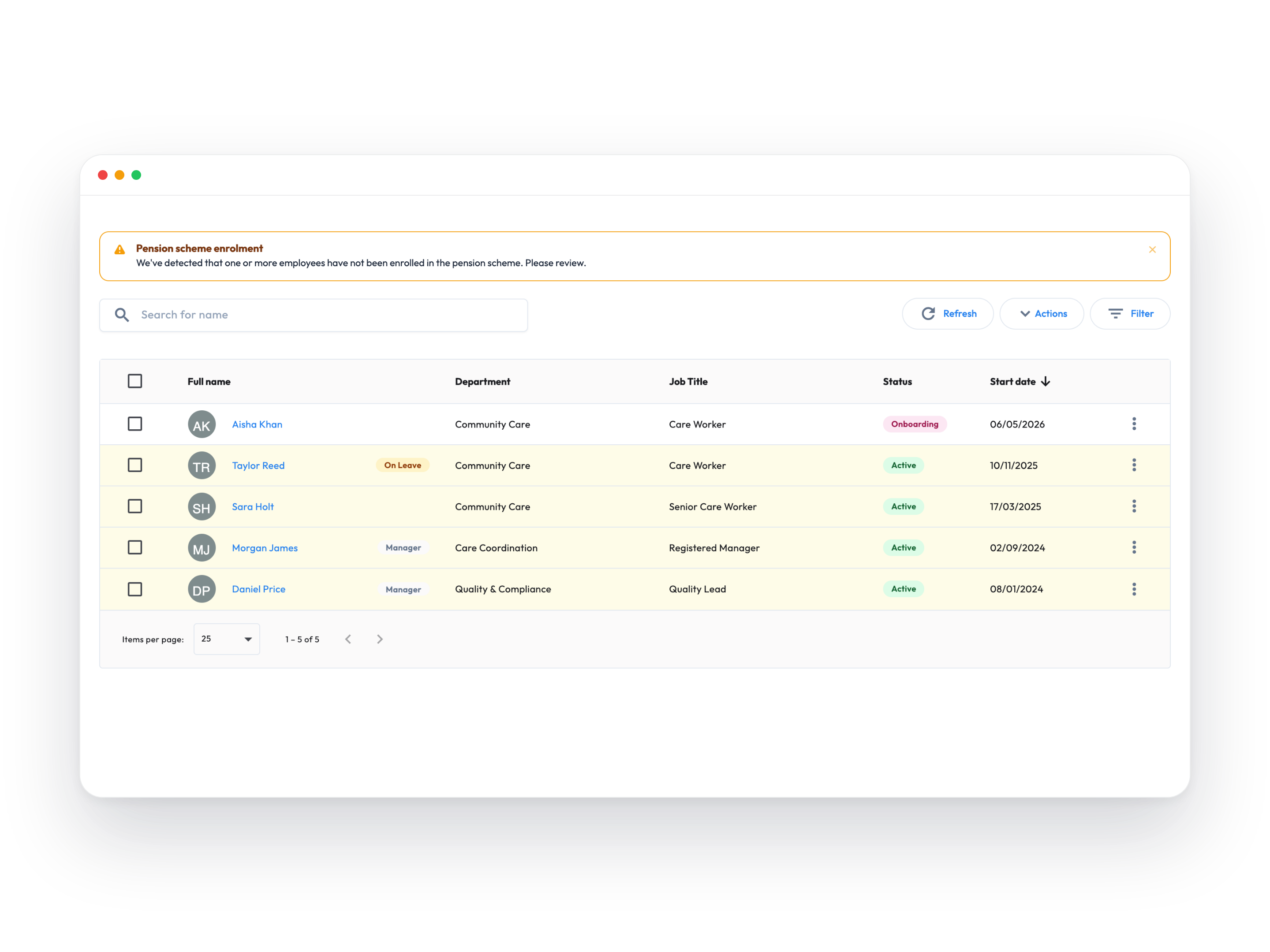
Workmax connects employee records, documents, leave, availability, scheduling, worked time and payroll inputs. Managers remain responsible for recruitment, suitability, staffing and employment decisions.