
PATHWAY 04 · LESSON 01
How to calculate care-worker demand and usable capacity
Calculate domiciliary care staffing demand, usable worker capacity, peak-time gaps and skill-mix risks before committing visits to the rota.
Applies to: CQC staffing requirements apply to regulated providers in England. Working-time, contract and employment rules can change how much availability is usable; check the current rules and individual arrangements before relying on a capacity figure.
- Practical guide
- 13 min read
- Reviewed 10 August 2026
- 6 official sources checked
What this guide covers
- Choose the planning window and operating area
- Convert care into worker-hours
- Add travel and required non-contact work
- Add a named contingency allowance
Quick answer
Calculate worker-hours of demand first, subtract real constraints from supply, then test the result at the busiest time and for each required skill.
Do not calculate capacity by counting employees or adding contracted hours. Start with the care that must be delivered: the duration, timing, location, travel, double-up requirement, continuity expectation and skills needed for every visit. Then compare that demand with workers who are actually available, rested, competent, authorised and suitable in the same time band and area.
A weekly surplus can still contain a morning shortage, a medicines gap or an uncovered double-up call. Use hours as the first calculation, then test the result by time window, geography, skill and continuity. Keep the assumptions and management decision so the provider can explain why work was accepted, delayed, redesigned or declined.

Who should use this capacity review
Use it before accepting a new package, publishing a rota or responding to a material change in needs, availability or workforce risk.
- Registered managers and nominated individuals
- Care coordinators and rostering leads
- Workforce, recruitment and learning leads
- Operations and finance leaders testing sustainable growth
Decision process
Turn care demand into a defensible capacity decision
Use one agreed planning window and preserve each adjustment. Recalculate when the care pattern or workforce position changes.
- 01
Choose the planning window and operating area
Define the dates, service, branch or zone and time bands being tested. Use a short operational horizon for rota decisions and a longer horizon for recruitment, training and growth.
- 02
Convert care into worker-hours
Total each planned visit at its assessed duration. Multiply double-up time by the number of workers required and keep time-critical windows visible instead of spreading demand evenly across the day.
- 03
Add travel and required non-contact work
Use realistic route travel, handovers, care-record completion, coordination and other work needed to deliver the service. Do not treat travel between assignments as spare capacity.
- 04
Add a named contingency allowance
Set and record the provider’s evidence-based allowance for predictable disruption such as short-notice absence, overruns and urgent changes. A buffer is a planning control, not proof that every risk is covered.
- 05
Build gross supply from confirmed availability
Use availability for the same dates, time bands and areas. Distinguish contracted hours, additional hours a worker has actually agreed and agency or bank cover that is genuinely confirmed.
- 06
Remove unavailable and non-deployable time
Subtract leave, known absence, training, supervision, meetings and other committed work. Apply working-time and rest constraints, then remove time that cannot be used because competence, authorisation, restrictions, transport or location do not match.
- 07
Test peak, skill, geography and continuity
Compare demand and capacity within each material time band and area. Check medicines, delegated activities, moving and handling, double-up calls, language or communication needs and the familiar worker team around each person.
- 08
Resolve the gap without weakening the care plan
Use safe options such as confirmed cover, recruitment, training, different worker availability or a discussion with the person and commissioner about an agreed change. Do not shorten, move or remove care only to make the arithmetic fit.
- 09
Approve, monitor and trigger review
Record the decision owner, assumptions, residual risk and review date. Recalculate after new packages, changed needs, leave, sickness, restrictions, incidents, missed visits, recruitment changes or repeated overtime.
Worked example
Worked example: enough weekly hours, not enough morning capacity
This illustrative review shows why a headline total is only the first test. All figures are synthetic planning inputs, not a staffing ratio or legal safe minimum.
Scenario
A branch reviews one locality for next week before accepting another morning care package. The planning window covers all paid and operational work needed to deliver the current visits.
- Care demand
- 24 worker-hours of single-worker visits plus 4 additional worker-hours for double-up calls = 28 worker-hours.
- Travel and support work
- Add 5 hours of route travel, 2 hours for handovers and records, and a documented 3-hour contingency allowance. Total demand = 38 hours.
- Gross worker supply
- Confirmed availability in the locality totals 50 hours. This includes only contracted hours and additional availability workers have agreed for the week.
- Usable capacity
- Subtract 5 hours of leave or known absence, 3 hours of training and supervision, and 2 hours that cannot be deployed because of timing or restrictions. Usable capacity = 40 hours.
- Headline position
- 40 usable hours less 38 demand hours = 2 hours of apparent headroom. At weekly level the branch appears covered.
- Peak and skill test
- Between 07:00 and 10:00, demand is 16 worker-hours but matching capacity is 13. Two time-critical medicines visits also require an authorised worker. The real decision is a 3-hour morning gap, not a 2-hour surplus.
- Management decision
- Do not accept the additional morning package yet. Seek suitable confirmed cover, adjust availability or agree a person-led service change through the proper process; record the owner and review date.
A percentage buffer is not set by CQC or NICE. Choose it from your own absence, overrun, travel and exception evidence, and test whether the reserved capacity is usable at the point of risk.
Printable working template
Care demand and usable-capacity review record
Print this page or use these fields in your operating record. Complete one record for each material planning window and area.
Planning scope
- Service, branch or locality
- Dates and named time bands
- Prepared by, reviewed by and decision date
- Trigger: routine review, new package or changed risk
Demand calculation
- Visit worker-hours, including the extra worker on double-up calls
- Travel between assignments and realistic route assumptions
- Handovers, records, coordination and other required work
- Contingency allowance, method and evidence used
- Total demand by time band, geography and required skill
Capacity calculation
- Confirmed gross availability for the same window
- Leave, absence, training, supervision and committed work deducted
- Working-time, rest, transport and location constraints applied
- Competence, authorisation, restriction and continuity filters applied
- Usable capacity by time band, geography and required skill
Decision and follow-up
- Gap or headroom, including the peak-time result
- Options considered and people consulted
- Approved action, owner and deadline
- Residual risk and contingency arrangement
- Review date and event-triggered review conditions
Do not use this record as a fixed staffing ratio. Link it to current care plans, worker status, rota evidence and the management decision.
Practical checklist
Care-worker demand and capacity checklist
Complete these checks before treating the workforce as able to deliver the plan.
- The planning dates, locality and time bands are explicit
- Demand starts with current assessed care and support needs
- Visit duration is counted as worker-hours, with double-up time multiplied correctly
- Time-critical and flexible visits remain distinguishable
- Travel uses realistic routes and is not treated as spare time
- Handovers, records, coordination, training and supervision are visible
- The contingency allowance has a stated method and evidence base
- Supply uses confirmed availability rather than headcount or assumed overtime
- Leave, absence and other committed work are deducted once and clearly
- Working-time, rest, contract and policy constraints have been checked
- Competence, authorisation and current restrictions are applied
- Transport, location, continuity and person-worker suitability are tested
- The peak-time result is reviewed separately from the weekly total
- A named manager owns every unresolved gap and contingency action
- No care is shortened or moved merely to make the capacity figure fit
- Changes, assumptions, approval and the next review trigger are recorded
Keep the demand-to-decision evidence chain
- Planning window, locality, service and time-band definitions
- Current care plans, visit durations, time windows and double-up requirements
- Travel assumptions, route evidence and required non-contact work
- Contingency method and the operational evidence supporting it
- Worker availability, agreed additional hours, leave and absence
- Training, supervision, meetings and other committed work
- Working-time, rest, contract and policy checks
- Current competence, authorisation, restrictions and transport status
- Demand and usable-capacity totals by time, geography and skill
- Options considered, consultation and the approved response
- Residual risks, contingency owner and escalation route
- Review date, trigger events and evidence of the next recalculation
Where care capacity calculations fail
Headcount is treated as capacity
The provider counts employed workers without checking when, where or for what work they can actually be deployed.
Double-up care is counted once
A one-hour visit requiring two workers is recorded as one worker-hour, creating a hidden one-hour shortage.
Travel disappears between visits
The rota uses every minute for contact time even though workers must move safely between people’s homes.
A weekly surplus hides a morning gap
Hours available later in the day are used to offset time-critical demand that occurs at breakfast or bedtime.
Availability bypasses suitability
A free worker is treated as interchangeable despite competence, authorisation, restrictions, continuity or person-specific needs.
The buffer becomes a magic number
A percentage is copied forward without checking absence, travel, overrun and exception patterns or whether the capacity is usable at the point of risk.
Growth is committed before the gap is resolved
A package is accepted on assumed recruitment, overtime or agency cover rather than confirmed deployable capacity.
Check the source
Current sources for staffing and working-time decisions
Reviewed 10 August 2026. The calculation in this lesson is an operational planning method, not a statutory staffing ratio. Apply current care plans, contracts, policies and individual circumstances.
- CQC Regulation 18: staffingThe requirement for sufficient numbers of suitably qualified, competent, skilled and experienced staff, supported by a systematic approach to numbers and skill mix.
- CQC: safe and effective staffing quality statementCQC’s current statement on appropriate staffing levels, skill mix, support and safe care that meets individual needs.
- NICE NG21: home care recommendationsPerson-worker matching, continuity, sufficient visit length, realistic travel time and action on missed or late visits.
- Skills for Care: operational workforce planningThe analyse, plan, do and review approach and provider resources for understanding current and future workforce needs.
- GOV.UK: maximum weekly working hoursCurrent overview of the 48-hour average, usual reference period, opt-outs, exceptions and employer record responsibilities.
- GOV.UK: rest breaks at workCurrent overview of rest breaks, daily rest and weekly rest; exceptions and compensatory rest require case-specific checking.
Continue learning
Continue from capacity planning to live workforce control
Pathway 04 owns workforce demand, usable capacity and continuing deployability. Pathway 03 owns matching named workers to individual visits and managing delivery. Pathway 06 owns payroll treatment and package economics.
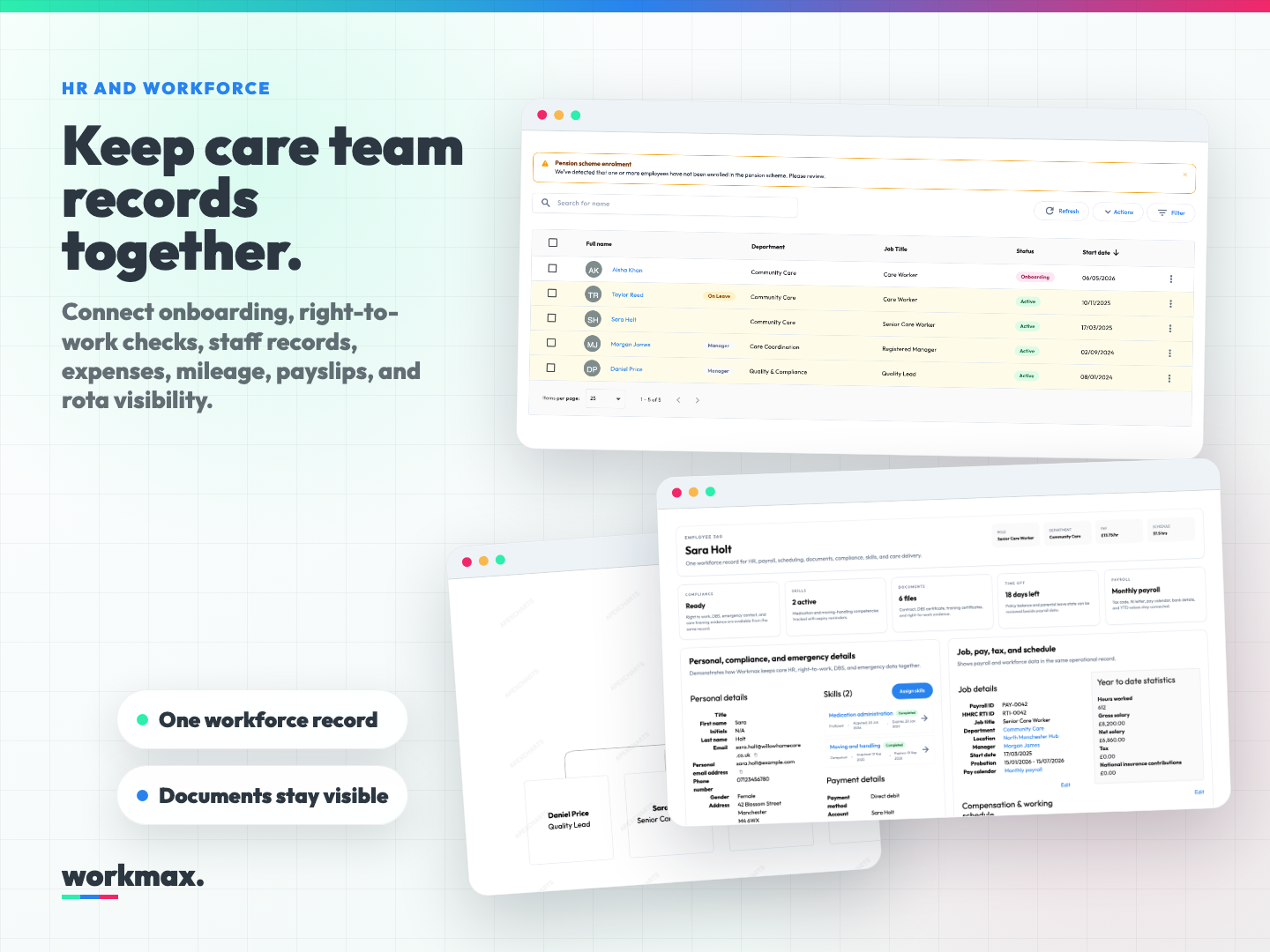
A RESTRAINED WORKMAX CONNECTION
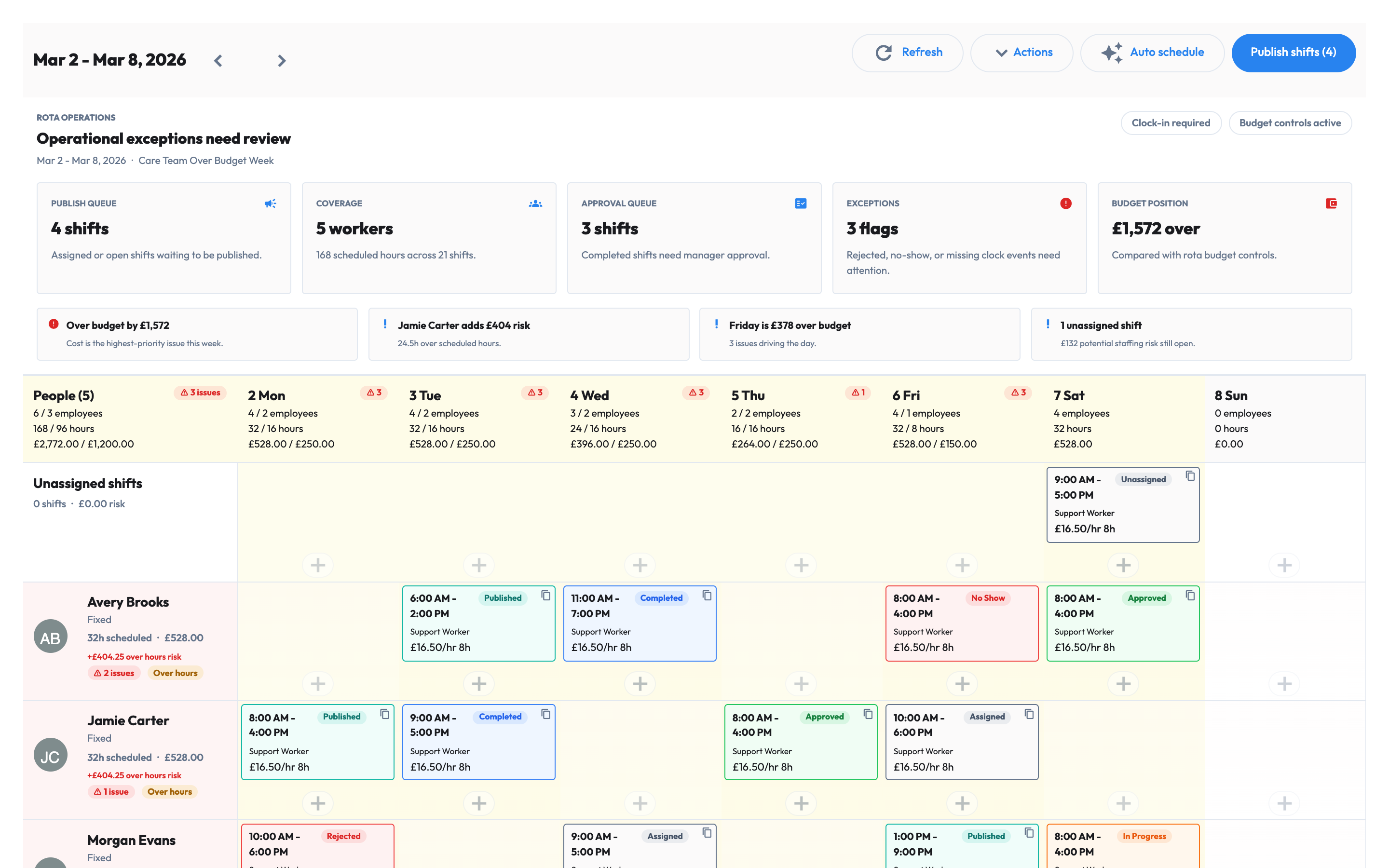
Keep demand, worker status and rota pressure visible together
Workmax can help connect care schedules, availability, leave, competence, restrictions and rota coverage. It does not set a safe staffing ratio or decide whether a package can be delivered safely; the provider remains responsible for the calculation, judgement and response.
Continue through the hub
Related pathways
Recruit and onboard staff
Build the initial suitability, competence and deployment evidence that becomes usable workforce supply.
Plan and deliver care
Turn available workforce capacity into person-specific assignments and controlled visits.
Run a profitable agency
Keep operational capacity distinct from pay interpretation, employment cost and package margin.