
PATHWAY 06 · SLEEP-IN OPERATIONS
How to run sleep-in shifts with CQC-ready evidence
Plan, record, review and pay for sleep-ins, waking nights and overnight exceptions with evidence that supports safe care and good governance.
Applies to: England CQC evidence guidance and UK payroll guidance. This is not legal advice; apply the contract, actual working arrangements, current guidance and professional advice where needed.
- Practical guide
- 24 min read
- Reviewed 23 July 2026
- 7 official sources checked
What this guide covers
- Confirm the assessed overnight need
- Choose the correct arrangement
- Check worker suitability and rest
- Define facilities, handover and escalation
Quick answer
Plan, record, review and pay for overnight support without treating the sleep-in label as the answer.
A sleep-in is not CQC-ready because it appears on the rota. CQC-ready evidence means records that help demonstrate safe, person-centred and well-governed overnight care. It does not guarantee compliance or a particular CQC assessment outcome.
The rota label does not determine the legal or payroll treatment. Providers must examine the contract, the expected duties, the sleeping arrangements and what actually happened during the shift, then keep enough evidence for care review, governance and payroll.
Separate the decisions
Separate four decisions providers often mix together
One overnight shift can raise care, staffing, employment and minimum-wage questions. Answer them separately so a rota code does not become a substitute for judgement.
The rota label does not determine the legal or payroll treatment. Providers must examine the contract, the expected duties, the sleeping arrangements and what actually happened during the shift.
Care manager
Care-planning decision
What overnight support does the person need, and why is that model safe and person-centred?
Registered manager or rota manager
Staffing decision
What arrangement, competency, continuity, rest and escalation cover are required?
HR or provider leadership
Employment decision
What do the contract, working pattern, sleep facilities and expected duties require?
Payroll compliance owner
Minimum-wage decision
Which hours and payments count across the applicable pay reference period under the current rules?
Choose the arrangement
Choose the overnight arrangement from the person’s needs and the real duties
The arrangement should follow the assessed overnight need and the worker’s expected responsibilities, not the cheapest label available in the rota.
| Arrangement | Use when | Evidence needed |
|---|---|---|
| Sleep-in | The worker is expected to sleep and may be required to respond if needed. | Care-plan rationale, sleeping facilities, expected response duties, interruptions and awake-for-work time. |
| Waking night | The worker is expected to remain awake for most or all of the shift and deliver planned or responsive support. | Night plan, required tasks, observation or support schedule, competency and working-time controls. |
| On-call | The worker is available to respond but is not necessarily at the person’s home or working throughout. | Location requirement, response window, call-out record, actual work and pay rule. |
| Live-in or overnight support | The worker’s presence and duties are part of a wider live-in or extended-care arrangement. | Contractual model, care plan, rest and privacy arrangements, duties and actual work performed. |
Make ownership visible
Keep the evidence, owner and review trigger together
This matrix connects safe care, staffing and governance records so inspection evidence is created through normal work rather than rebuilt later.
| Decision or event | Evidence to retain | Owner | Review trigger |
|---|---|---|---|
| Overnight support selected | Needs assessment and care-plan rationale | Care manager | Change in needs |
| Worker assigned | Competency, training and suitability | Rota manager | Expired training or new risk |
| Sleeping facility approved | Facility check and identified limitations | Registered manager | Location or environment change |
| Worker awakened | Start/end time, reason and support delivered | Care worker | Every interruption |
| Incident occurred | Incident reference and immediate action | Care worker or manager | Same shift |
| Pay approved | Allowance, working time, corrections and NMW result | Payroll approver | Every pay period |
| Pattern identified | Frequency and duration trend | Registered manager | Defined threshold exceeded |
Provider-defined thresholds
Define when a nominal sleep-in needs review
These are provider-defined operational triggers, not legal thresholds. They help managers notice when the planned model no longer matches the person’s needs or the work being performed.
Review triggers
- More interruptions than the care plan anticipates.
- Prolonged awake-for-work periods.
- The worker cannot realistically use the sleeping facilities.
- Repeated incidents or emergency escalation.
- Fatigue, rest or welfare concerns.
- The same manual payroll correction recurring.
- Overnight needs materially changing.
- Feedback suggesting the arrangement is no longer suitable.
Possible outcomes
- Revise the care plan, risk assessment or overnight support instructions.
- Add training, supervision, equipment or escalation controls.
- Change staffing levels, continuity arrangements or worker suitability rules.
- Move from a nominal sleep-in to waking-night provision where the evidence supports it.
- Update payroll rules, approval checks and audit sampling.
Worked overnight scenario
A complete sleep-in record should show the chain, not a universal pay answer
This example deliberately avoids calculating pay because the answer depends on contracts, facts, pay structure and the full pay reference period.
- 22:00
Planned sleep-in begins
The rota links the shift to the care plan, worker assignment, sleeping-facility check and expected escalation route.
- 00:40
First interruption starts
Worker records reassurance provided from 00:40 to 00:55 and links the note to the overnight record.
- 03:10
Second interruption starts
Worker records personal care from 03:10 to 03:50, raises an incident and records immediate action.
- 07:00
Shift closes
The sleep-in record preserves planned time, waking periods, daily notes, incident reference and any handover.
- Review
Manager confirms the facts
The manager reviews awake-for-work periods, incident action, care-plan implications and the payroll input before cut-off.
- Month
Pattern audit updates the model
Repeated interruptions feed into a monthly review of whether waking-night support is now more appropriate.
Whole pay-reference-period check
Approve pay from the full record and the full pay reference period
Contractual pay entitlement and National Minimum Wage compliance are related but separate questions. Payroll should not be asked to guess what happened overnight.
Do not assume that the sleep-in allowance alone can be compared with an hourly National Minimum Wage rate.
- Confirm the contract, pay rule, allowance, premium and any waking-time treatment.
- Determine the worker’s National Minimum Wage work type.
- Identify all hours that count under the current rules.
- Identify all pay that counts under the current rules.
- Perform the minimum-wage calculation across the applicable pay reference period.
- Retain the calculation, source records, corrections and approval decision.
Related controls
Connect the overnight record to the rest of the hub
Sleep-in evidence touches care planning, staffing, incident review, deployment and payroll. Keep those controls linked rather than treating the sleep-in as a standalone pay code.
Plan and deliver care
Trace overnight support back to assessed needs, visit records and care-plan review.
Manage the care workforce
Review staffing capacity, rest, fatigue, supervision and safe deployment.
Prepare CQC evidence
Use overnight records as part of safe, effective and well-led evidence.
Control payroll and costs
Approve overnight work before payroll and minimum-wage checks.
Assess care-worker competence
Check whether the worker is competent for overnight risks and tasks.
Authorise safe deployment
Make overnight duties and restrictions visible before assigning work.
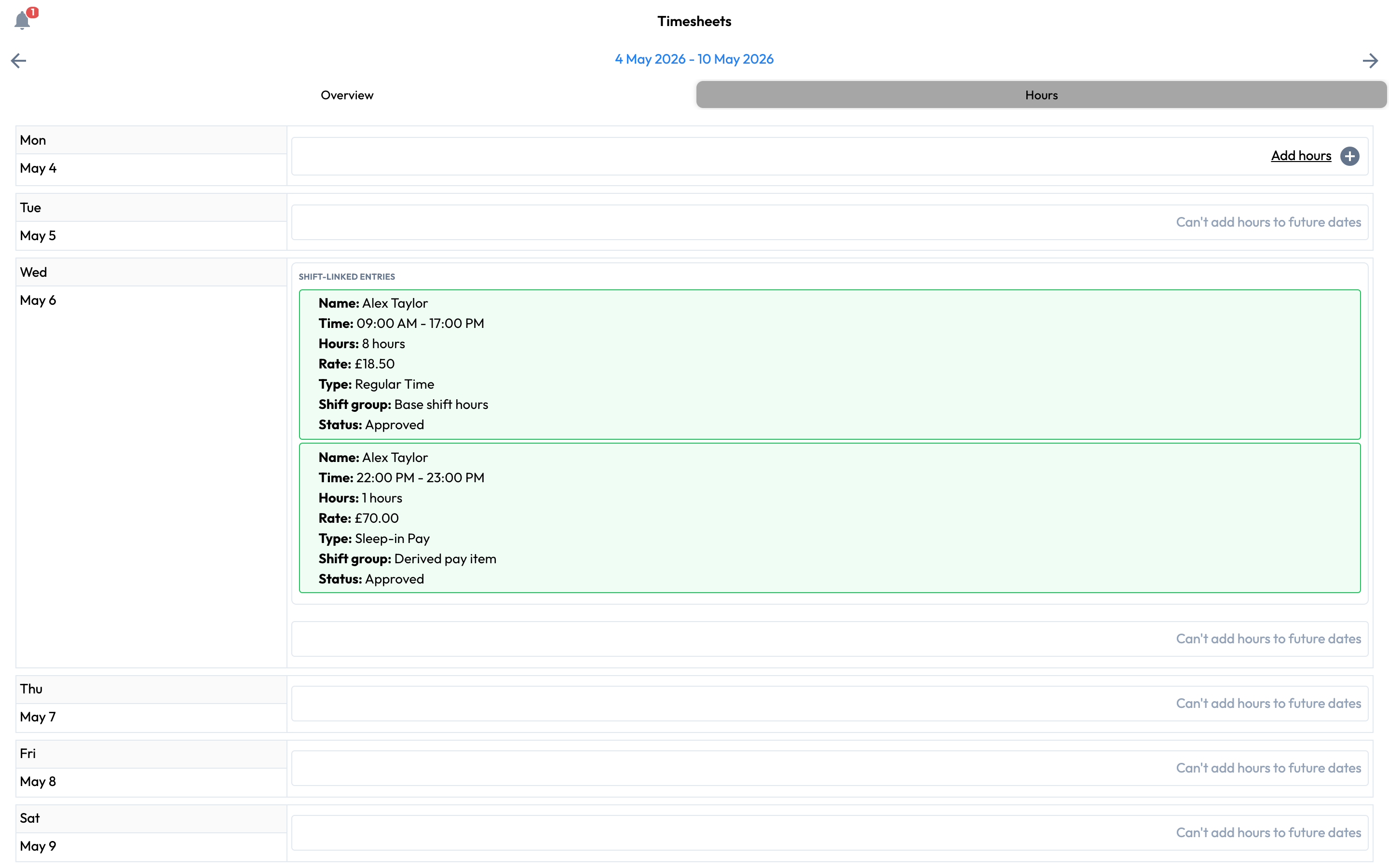
Who this guide is for
Use this guide when overnight support, care evidence and payroll approval are owned by different people or systems.
- Registered managers and nominated individuals
- Care coordinators and rota managers
- Care managers and field supervisors
- Payroll, HR and finance approvers
Decision process
Run the complete overnight operating chain
A sleep-in should trace from assessed need to pay approval and back into care-plan review when patterns change.
- 01
Confirm the assessed overnight need
Record why overnight support is required and what outcome or risk it addresses.
- 02
Choose the correct arrangement
Decide whether the evidence supports a sleep-in, waking night, on-call or another overnight model.
- 03
Check worker suitability and rest
Confirm competence, continuity, workload, fatigue risk and any person-specific restrictions.
- 04
Define facilities, handover and escalation
Record sleeping arrangements, limitations, response duties and who is contacted if risk changes.
- 05
Capture interruptions and awake-for-work time
Record start and end time, reason, support delivered and whether an incident or note was created.
- 06
Link incidents, notes and care-plan changes
Keep overnight activity connected to the person’s care record and follow-up actions.
- 07
Approve operational exceptions before payroll
Managers confirm facts, corrections and unresolved questions before payroll input is locked.
- 08
Check minimum wage and retain evidence
Payroll applies current rules across the applicable pay reference period and keeps the supporting calculation.
- 09
Audit patterns and update the model
Use interruptions, incidents, fatigue and feedback to decide whether the planned arrangement remains suitable.
Practical checklist
Sleep-in operating checklist
Use this before publishing the rota and again before payroll closes.
- The care plan explains why overnight support is required.
- The arrangement is classified as sleep-in, waking night, on-call or another model from the facts.
- Worker competency, suitability, continuity and rest have been considered.
- Sleeping facilities and limitations are recorded where a sleep-in is planned.
- Handover, escalation and emergency response expectations are visible.
- Every interruption records start time, end time, reason and support delivered.
- Incidents, daily notes and overnight records are linked.
- A manager reviews unusual activity and repeated waking.
- Payroll inputs are approved from the operational record rather than memory.
- Contractual pay treatment and NMW compliance are considered separately.
- Minimum wage is checked across the applicable pay reference period.
- Repeated triggers lead to care-plan, staffing or payroll-control review.
Records behind a CQC-ready overnight chain
- Needs assessment, care plan and overnight support rationale
- Arrangement classification and manager rationale
- Worker competency, deployment authorisation and suitability record
- Sleeping-facility check and known limitations
- Published rota, handover and escalation instructions
- Interruption log with start time, end time, reason and support delivered
- Daily notes, incidents, safeguarding actions and follow-up records
- Manager review, corrections and approval history
- Payroll input, NMW pay-reference-period calculation and adjustment records
- Pattern audit, care-plan review and staffing-model decisions
Where sleep-in controls commonly break
The label becomes the decision
A shift is called a sleep-in even though duties, interruptions or facilities suggest a different operating model may be needed.
Waking time is recorded in notes only
Care notes describe overnight work, but the timesheet and payroll input do not retain the same facts.
Facilities are assumed
The provider cannot show that suitable sleeping arrangements were available or explain any limitation.
Incidents do not trigger review
Overnight incidents are closed individually without asking whether the care plan or staffing model should change.
Payroll calculates from memory
The approver reconstructs waking time from messages after cut-off instead of using a controlled overnight record.
CQC-ready is overstated
The service treats a completed form as proof of compliance rather than evidence to support safe care and good governance.
Check the source
Sources and further guidance
Reviewed 23 July 2026. Use the current source for the relevant service, worker and pay period.
- HMRC National Minimum Wage Manual: sleeping timeHMRC guidance on sleeping time, availability and suitable sleeping facilities.
- GOV.UK: working hours for minimum wageWorking hours for minimum-wage purposes, including availability and sleep-related examples.
- GOV.UK: National Minimum Wage ratesCurrent and previous statutory hourly rates.
- CQC assessment frameworkCurrent assessment approach, five key questions, quality statements and evidence categories.
- CQC Regulation 12: safe care and treatmentProvider guidance on assessing risk and doing all that is reasonably practicable to mitigate it.
- CQC Regulation 17: good governanceProvider guidance on systems, processes, records and assessing service quality and safety.
- CQC Regulation 18: staffingProvider guidance on sufficient, competent, skilled and experienced staff.
Continue learning
Related overnight and payroll topics to build next
This guide sets the operating chain. Future supporting guides can go deeper on documents, audits and pay-period examples.
- Sleep-in policy template
- Waking-night review checklist
- Overnight incident audit
- Manager approval workflow
- Pay-reference-period worked examples
- Staff fatigue and rest review
- Family and commissioner communication
- Care-plan review after repeated waking
A RESTRAINED WORKMAX CONNECTION
Join overnight evidence before it becomes a payroll dispute
Workmax connects rota records, care delivery evidence, incidents, manager approval and payroll-ready records. Providers still define care plans, staffing decisions, employment terms and compliance checks.
Continue through the hub
Related pathways
Plan and deliver care
Connect overnight support to assessed needs, visits and exceptions.
Manage the care workforce
Review competence, staffing, rest and fatigue risk.
Control payroll and costs
Approve overnight work before payroll and pay-reference-period checks.
Home care payroll software
See how approved sleep-ins, waking time, mileage and visit records can move into payroll.
Visit-to-payroll readiness scorecard
Diagnose whether sleep-ins and other visit exceptions are reviewed before payroll.